Taras Hryhorovych Shevchenko Arrives From His Exile to Flowering Ukraine
Details
Expertenanalyse zu Maria Primachenkos Taras Hryhorovych Shevchenko Arrives From His Exile to Flowering Ukraine
Stil: Naïve Art (Primitivism) · Genre: portrait
Expert Analysis: "Taras Hryhorovych Shevchenko Arrives From His Exile to Flowering Ukraine" by Maria Primachenko
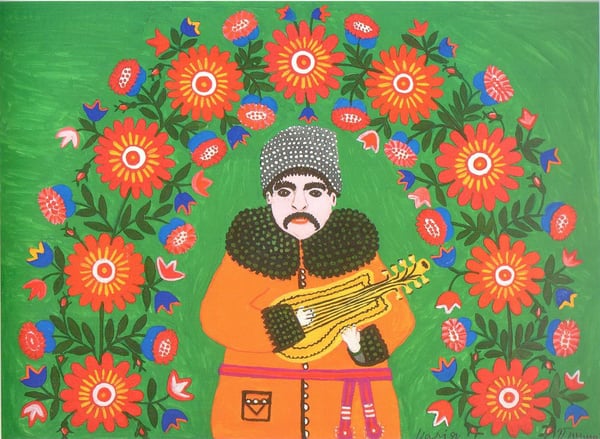
Maria Primachenko (1909–1997) is one of the most celebrated figures in Ukrainian Naïve Art (Primitivism), a style characterized by bold, unpretentious forms, vibrant colors, and a deep connection to folk traditions. This painting, a portrait of the iconic Ukrainian poet and artist Taras Hryhorovych Shevchenko, transforms a historical narrative into a mythic, celebratory vision. Shevchenko endured years of exile (c. 1847–1857) for his nationalist and anti-serfdom writings, and Primachenko captures his triumphal return to a "flowering" Ukraine—a land reborn in bloom.
What makes this work significant within the Naïve Art movement is its synthesis of personal, political, and folkloric elements. Primachenko eschews academic perspective and naturalistic proportion in favor of a flat, decorative composition. Shevchenko’s figure is likely rendered with the same direct, emblematic clarity found in Ukrainian folk icons and embroidery. The "flowering" landscape is not a realistic backdrop but a symbolic tapestry of oversized blossoms, leaves, and possibly magical or totemic animals—hallmarks of Primachenko’s unique visual language. The color palette is intense and emotionally charged: deep reds, sunlit yellows, and lush greens that convey vitality and national pride.
As a portrait, the work transcends individual likeness to become an allegory of Ukrainian cultural rebirth. Shevchenko is not just a man returning from exile; he is a national soul arriving in a resurrected homeland. Primachenko’s Primitivism strips away academic artifice to reveal a raw, spiritual truth, one that aligns with Shevchenko’s own role as a voice for the oppressed. The painting’s significance lies in how it uses the naïf aesthetic—seemingly simple but deeply coded—to reclaim a painful history and transform it into a vision of hope, resilience, and flourishing identity. It stands as a powerful example of how Naïve Art can serve as both personal expression and collective memory.
Visuell ähnlich
20 Werke mit ähnlicher Komposition und Farbpalette
Cover of Volodymyr Narbut's book 'Hallelujah'
Heorhiy Narbut
Georgian woman with thari
Niko Pirosmani
Boyarin and boyarynia
Nicholas Roerich
Lunch in vineyard
Ivan Generalic
Balalaika Player
Nikolay Bogdanov-Belsky
Cover of magazine 'Art'
Heorhiy Narbut
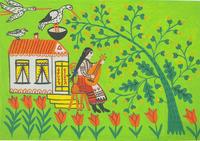
Maiden Plays the Lute and Waits for her Beloved
Maria Primachenko
Tatar Woman With Mandoline
Iosif Iser
Mamay
Ivan-Valentyn Zadorozhny
Stacy Pace Karnival
Stacy Pace
Boyarin
Nicholas Roerich
Triptych. Bandura-player.
Pyotr Konchalovsky
Sayat Nova
Martiros Sarian
Woman
Henri Matisse
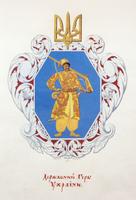
Small coat of arms the Ukrainian State
Heorhiy Narbut
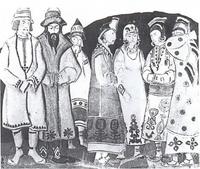
The scene with seven figures in costumes
Nicholas Roerich
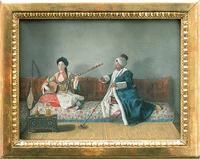
Monsieur Levett and Mademoiselle Glavani in Turkish Costume
Jean-Étienne Liotard
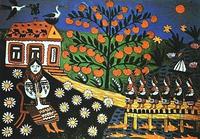
Years of My Youth, Come Visit Me
Maria Primachenko
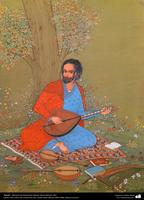
Ormavi
Hossein Behzad
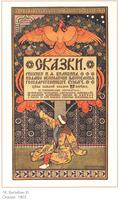
Cover for the collection of fairy tales
Ivan Bilibin