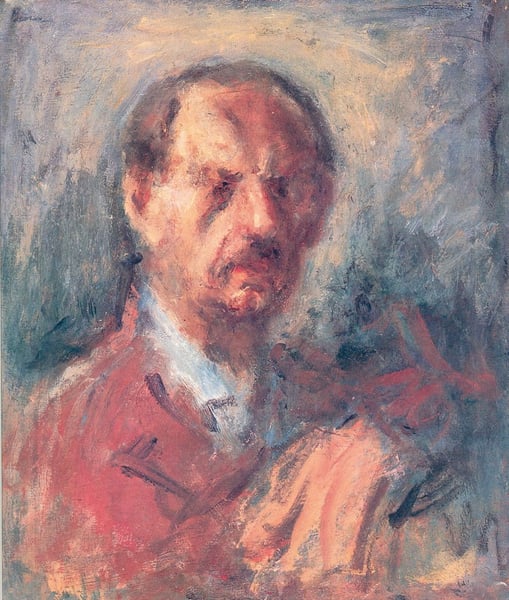
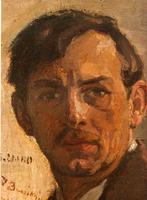
Self Portrait
Expertenanalyse zu George Bouzianiss Self Portrait
Stil: Expressionism · Genre: self-portrait
Expert Art Historical Analysis: "Self Portrait" by George Bouzianis
George Bouzianis (1885–1959) stands as a pivotal figure in the trajectory of 20th-century Greek modernism, and his Self Portrait is a consummate example of the Expressionist ethos as it manifested outside the movement’s Central European heartland. This work is significant not only for its raw psychological intensity but also for its role in transplants the emotional and formal radicalism of Expressionism into a Greek context, challenging the prevailing conservative academic traditions of his homeland.
Formal and Stylistic Significance Executed with Bouzianis’s characteristic impasto and gestural brutality, the Self Portrait forgoes verisimilitude in favor of internal truth. The face is rendered with exaggerated, almost mask-like features: hollowed eye sockets, asymmetrical cheekbones, and a taut, distorted jawline. Colour is used not descriptively but expressively—muddy ochres, livid greens, and stark darks create a portrait that seems to be decomposing under the pressure of the artist’s own self-scrutiny. The brushwork is turbulent, with visible, agitated strokes that convey a sense of existential anxiety.
Contextual and Historical Importance Bouzianis was among the first Greek artists to fully embrace the post–World War I Expressionist language. Having studied in Munich—then a crucible of the movement—he brought back a psychological depth that was largely absent in Greek portrait tradition. This Self Portrait is significant because it rejects the serene, idealized self-image typical of Greek academic portraiture. Instead, it reveals the artist as tormented, vulnerable, and radically honest—a mirror of the alienated modern self. Bouzianis’s work influenced later Greek avant-garde artists and helped establish Expressionism as a legitimate, if controversial, mode of national expression.
Thematic Weight In this self-portrait, the artist does not present a likeness but a state of being. The clenched facial muscles, the strangely glowing eyes, and the compressed spatial field all signal a man in confrontation with his own double—a theme central to Expressionist self-portraiture. Bouzianis aligns himself with the tradition of van Gogh, Munch, and Kokoschka, but he adds a distinctively Mediterranean, almost Byzantine sense of spiritual austerity. The work becomes a document of the artist’s inner exile, a motif that grants it lasting resonance in the history of self-portraiture.
Visuell ähnlich
20 Werke mit ähnlicher Komposition und Farbpalette
Self-Portrait
Theophrastos Triantafyllidis
Self portrait
Umberto Veruda
Self Portrait
Istvan Nagy
Portrait of Benedetto Junck
Tranquillo Cremona
Autoretrato
Vlady
Berény Róbert Önarckép, 1940
Berény Róbert
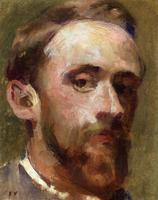
Self-Portrait
Edouard Vuillard
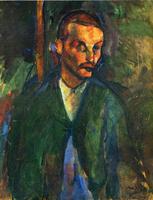
The beggar of Livorne
Amedeo Modigliani
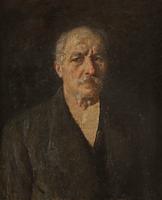
Self-portrait
Noè Bordignon
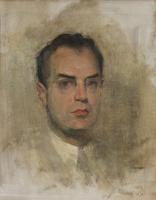
Untitled
Omer Mujadžić
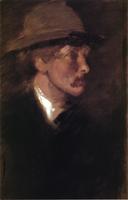
Study of a Head
James McNeill Whistler
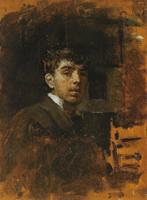
Self-portrait
Ettore Tito
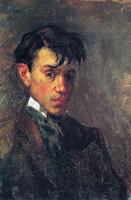
Self-Portrait
Pablo Picasso
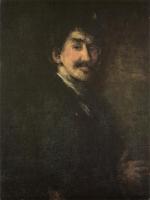
Gold and Brown (Self portrait)
James McNeill Whistler
Self-portrait
Istvan Nagy
Self-Portrait
Bertalan Por
Czóbel Önarckép
Bela Czobel
Self-Portrait
David Bomberg
Victor Chocquet
Paul Cezanne
Self Portrait
George Bouzianis