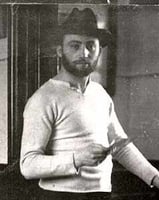
David Bomberg sanatçısının Self-Portrait eseri hakkında uzman analizi
Tarz: Expressionism · Tür: self-portrait
Expert Analysis of David Bomberg’s Self-Portrait (Expressionist style)
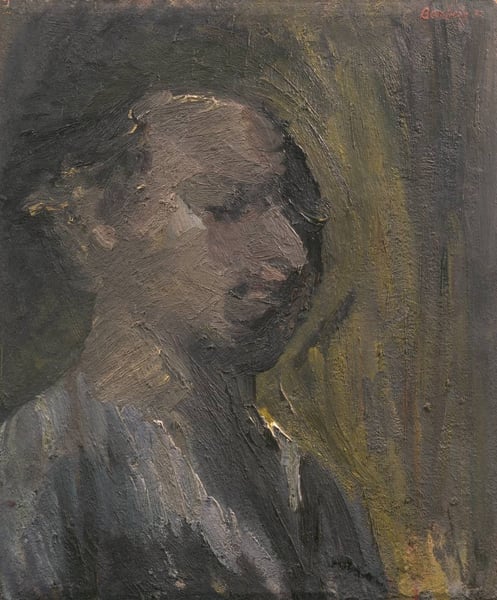
David Bomberg’s Self-Portrait stands as a compelling testament to the artist’s restless innovation within the Expressionist movement. Executed in a style that fuses the fragmented energy of his earlier Vorticist experiments with a raw, introspective emotionalism, the work transcends conventional self-portraiture.
Formal Innovation and Psychological Depth
Bomberg distorts his own features—sharpened planes, angular lines, and a compressed pictorial space—to convey not mere likeness but an inner psychological state. This is characteristic of Expressionism’s drive to externalize subjective experience. Unlike the academic realism dominant in British portraiture at the time, Bomberg prioritizes dynamic structure over naturalistic detail. The face becomes a battleground of geometric facets, each stroke imbued with an almost sculptural urgency. The eyes, often central to self-portraiture, are rendered as dark, penetrating voids, suggesting a guarded introspection—a hallmark of the artist’s personal grappling with identity and alienation in the modern world.
Significance within Expressionism and Bomberg’s Oeuvre
What makes this self-portrait especially significant is its position at the crossroads of two pivotal moments in modern art. Bomberg was a founder of Vorticism, Britain’s answer to Cubism and Futurism, but his later shift toward a more visceral, human-centered Expressionism is crystallized in this work. Here, the mechanical precision of Vorticism softens into a more expressive, almost violent handling of paint—the paint itself becomes a record of emotional pressure. The unfinished, raw quality of the brushwork signals an authenticity that Expressionism prized: the artist’s direct, unfiltered encounter with the self. In the context of early 20th-century British art, this Self-Portrait challenges the genteel tradition of the Royal Academy, asserting instead that portraiture can serve as a site of radical formal and emotional experimentation.
Ultimately, Bomberg’s Self-Portrait is not merely an image of the artist but a manifesto of Expressionist philosophy: the face is a landscape of feeling, and every line is a measure of lived experience. It remains a vital example of how self-portraiture, when stripped of convention, becomes a mirror to the turbulent soul of modernity itself.
Museum / Gallery
Görsel olarak benzer
İlişkili kompozisyon ve renk paletine sahip 20 eser
The Uncle
George Bouzianis
Meisje
Constant Permeke
Portrait
Oleg Holosiy
Self-Portrait
Theophrastos Triantafyllidis
Male Portrait
Oleg Holosiy
Modok Mária, Önarckép
Modok Mária
Self Portrait
Edgar Degas
Self portrait
Edvard Munch
Portrait
George Bouzianis
Self-Portrait as a young man
Francesco Paolo Michetti
Woman Profile
George Demetrescu Mirea
Severity
Robert Demachy
Portrait
George Bouzianis
Portrait of the Painter Waldmulle
George Bouzianis
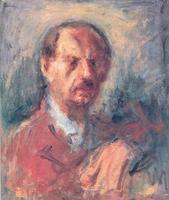
Self Portrait
George Bouzianis
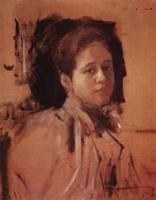
Portrait of Liudmila Mamontova
Valentin Serov
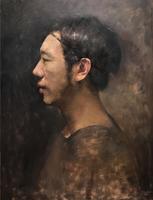
Self-Portrait
Kexin Di
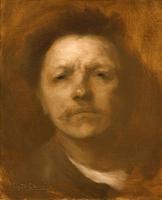
Self-portrait
Eugene Carriere
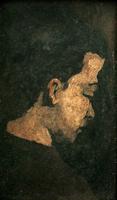
Study of the Head of a Youth
Theodule Ribot
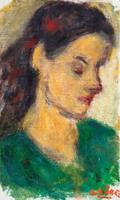
Czóbel Béla, Zöldruhás Nő
Bela Czobel