Expert analysis of George Bouzianis’s Trees in the riverside
Style: Expressionism · Genre: landscape
Expert Analysis of Trees in the Riverside by George Bouzianis
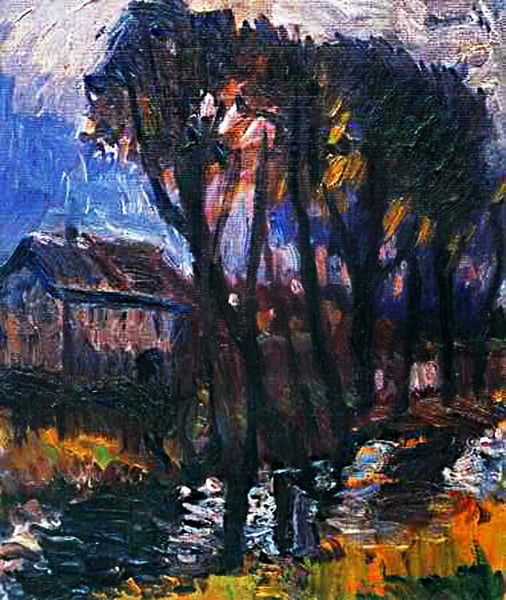
Within the canon of early 20th-century Expressionism, George Bouzianis’s Trees in the Riverside stands as a pivotal work that bridges the emotional intensity of Northern European Expressionism with the lyrical sensibility of Greek landscape tradition. Executed in the mature phase of his career, this landscape exemplifies Expressionism’s core tenet: the external scene is merely a vehicle for inner psychic states, not a literal transcription of nature.
Bouzianis—trained in Munich and deeply influenced by the raw energy of German Expressionist groups such as Die Brücke—transforms a simple riverside view into a charged, almost tremulous encounter. The “trees” are not rendered with botanical accuracy; instead, they likely pulse with distorted, upward-surging forms, their trunks and branches becoming expressive lines that convey agitation or yearning. The riverside itself would be subsumed into broad, unmodulated patches of color, perhaps using jarring contrasts of greens, blues, and earth tones, applied with a vigorous, visible brushstroke. This handling rejects Impressionist optical realism in favor of a subjective, often somber emotional register.
What makes this artwork significant within its style and period is twofold. First, it represents the mature synthesis of Bouzianis’s unique position: a Greek artist who internalized the angst and formal violence of early Expressionism (evident in the work of Nolde or Kirchner) yet filtered it through a distinctly Mediterranean sense of light and space. The riverside landscape, a common motif, is thus both universalized and particularized—it becomes a landscape of the soul, yet rooted in the specific topography of his homeland. Second, Bouzianis’s work is crucial for the development of modern Greek art, as Trees in the Riverside demonstrates that modernist expression could thrive outside the central European capitals. By applying Expressionism’s principles of emotional distortion and chromatic freedom to a native scene, Bouzianis forged a path for later Greek modernists, proving that the most inward, subjective art could still speak from a local place. This painting is therefore not merely a landscape; it is a manifesto of Expressionism’s capacity to be both radically personal and culturally resonant.
Visually similar
20 works with related composition and palette
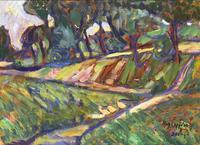
Egry József, Besnyői Táj
Egry József
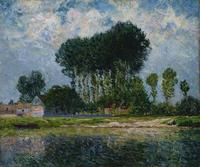
The River
Maxime Maufra
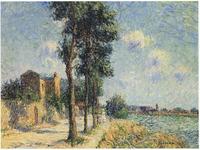
Quay at Dieppe
Gustave Loiseau
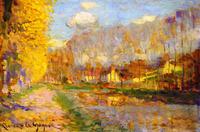
Canal du Loing, Moret
Clarence Gagnon
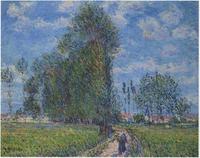
Path near Saint Cyr Vaudreuil
Gustave Loiseau
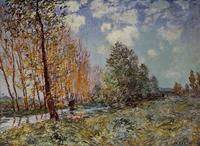
By the River
Alfred Sisley
Landscape with the Chateau of Auvers at Sunset
Vincent van Gogh
By the Oise River
Gustave Loiseau
Trees in Bloom
Gustave Loiseau
Egry József, Besnyői Táj, ,
Egry József
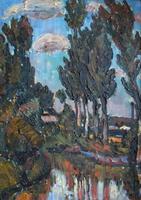
Lakeside trees
Istvan Nagy
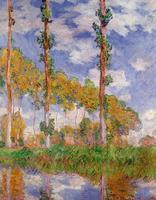
Three Trees in Summer
Claude Monet
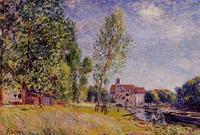
Matratat s Boatyard, Moret sur Loing
Alfred Sisley
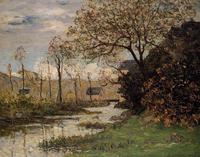
The Auray River
Maxime Maufra
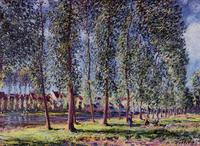
Lane of Poplars at Moret
Alfred Sisley
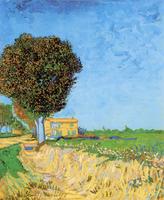
A Lane near Arles
Vincent van Gogh
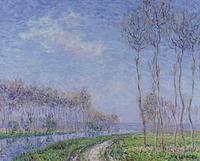
Trees by the River
Gustave Loiseau
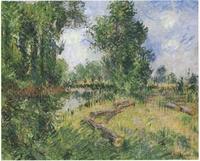
By the Orne River near Caen
Gustave Loiseau
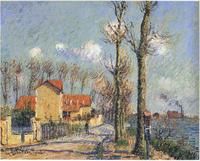
Quay of Pothius in Pontoise
Gustave Loiseau
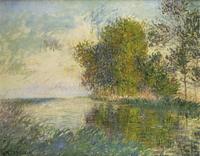
The Normandy River
Gustave Loiseau