Expert Analysis:
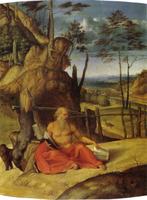
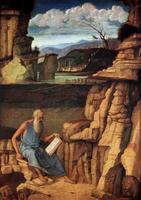
"St. Jerome in a Landscape" by Cima da Conegliano
As a High Renaissance religious painting, this work exemplifies the era’s quest for harmonious integration of sacred figures with their natural surroundings. Cima da Conegliano, a Venetian master of the late 15th to early 16th century, achieves a serene equilibrium between the penitential theme and the lush, atmospheric landscape.
Significance within the High Renaissance:
The painting is notable for its seamless fusion of devotional subject and pastoral setting—a hallmark of the High Renaissance’s move toward idealized naturalism. St. Jerome, depicted as a hermit in the wilderness, is not isolated from the landscape but is instead embedded within it, his contemplative pose echoing the calm of the surrounding hills, trees, and distant sky. This reflects the period’s belief that divinity could be perceived through the beauty and order of the natural world.
Cima’s handling of light and color, typical of the Venetian school, lends the scene a luminous, atmospheric unity. The careful rendering of foliage, rock formations, and soft gradations of sky demonstrates the High Renaissance’s emphasis on empirical observation balanced with idealization. The work stands as a testament to the era’s ambition: to elevate a traditional religious narrative into a timeless meditation on humanity’s place within a divinely ordered cosmos.