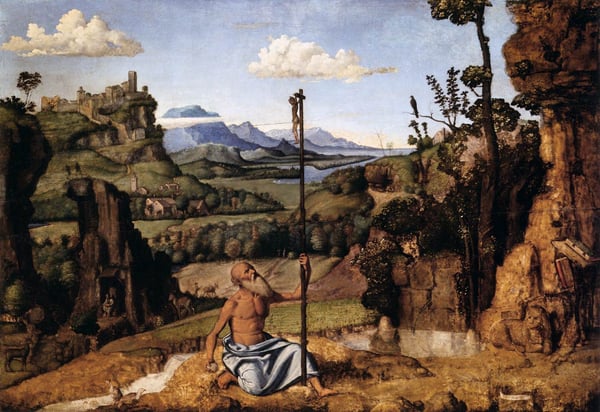
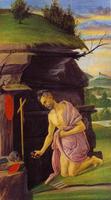
St. Jerome in the Wilderness
Dettagli
Analisi esperta di St. Jerome in the Wilderness di Cima da Conegliano
Stile: High Renaissance · Genere: religious painting
Expert Analysis: "St. Jerome in the Wilderness" by Cima da Conegliano
As a High Renaissance religious painting, St. Jerome in the Wilderness exemplifies the period’s pursuit of calm grandeur, balanced composition, and naturalistic detail. Cima da Conegliano, a Venetian master of the late 15th and early 16th centuries, imbues this devotional scene with the clarity of light and landscape that distinguishes the Venetian School.
Significance within the High Renaissance:
- Harmony of Man and Nature: The painting seamlessly integrates the solitary figure of St. Jerome—typically shown as a hermit scholar—into a broad, luminous landscape. This reflects the High Renaissance ideal of humans existing in a balanced, ordered universe, rendered through precise aerial perspective and soft atmospheric effects.
- Venetian Colorism: Cima’s use of rich, translucent colors and subtle gradations of light (derived from oil painting techniques) enhances the spiritual quietude of the wilderness. The warm hues of the saint’s robe contrast with the cool blues of the distant mountains, a hallmark of Venetian painting that prioritizes sensual beauty alongside religious narrative.
- Compositional Clarity: The figure of Jerome is placed slightly off-center, often with his lion and a crucifix, creating a stable yet dynamic triangular arrangement. This balanced structure—free of overcrowding—allows the viewer to meditate on both the saint’s penitence and the sublime landscape, a key trait of High Renaissance devotional works.
- Naturalistic Detail: Cima renders rocks, plants, and the saint’s aged features with careful observation, yet elevates them into an idealized, timeless setting. This blend of realism and idealism defines the High Renaissance approach, where earthly elements point to divine truth.
Significance of Subject:
St. Jerome was a Church Father famed for translating the Bible into Latin (the Vulgate) and for his ascetic life in the desert. Cima’s treatment emphasizes not dramatic suffering but serene contemplation—a scholarly withdrawal into nature. The wilderness is not a harsh desert but a lush, ordered landscape, suggesting that spiritual insight comes through harmonious immersion in God’s creation.
In sum, St. Jerome in the Wilderness is significant as a quintessential Venetian High Renaissance work: it marries robust naturalism with devotional calm, using luminous color and balanced design to elevate a traditional religious theme into a vision of earthly and celestial harmony.
Visivamente simili
20 opere con composizione e palette affini
Rocky Landscape with Saint Jerome
Joachim Patinir
St. Jerome in the Desert
Lorenzo Lotto
Diptych
Albrecht Altdorfer
St. Jerome in the Desert
Giovanni Bellini
The Penitent St Jerome
Filippino Lippi
Saint Jerome in the Wilderness
Pinturicchio
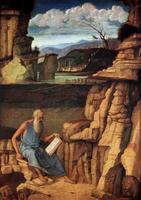
St Jerome Reading in the Countryside
Giovanni Bellini
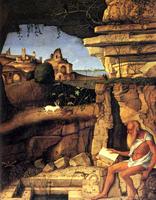
Saint Jerome Reading
Giovanni Bellini
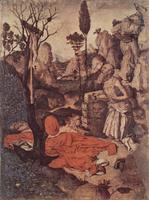
St. Jerome Penitent
Antonello da Messina
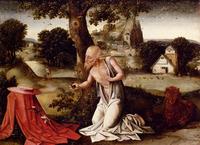
Landscape With The Penitent Saint Jerome
Joachim Patinir
Law and Grace
Lucas Cranach the Elder
Landscape with St. John the Baptist Preaching
Joachim Patinir

Penitent St. Jerome
Albrecht Altdorfer
Resurrection of Christ
Giovanni Bellini
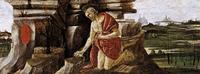
St Jerome in Penitence, predella panel from the Altarpiece of St Mark
Sandro Botticelli
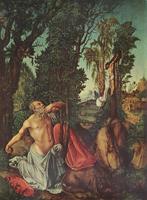
The Penitence of St. Jerome
Lucas Cranach the Elder
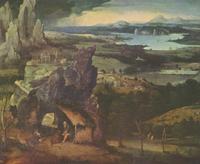
Landscape with St. Jerome
Joachim Patinir
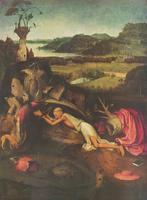
St. Jerome Praying
Hieronymus Bosch
Saint Christopher
Hieronymus Bosch
St.Jerome
Sandro Botticelli