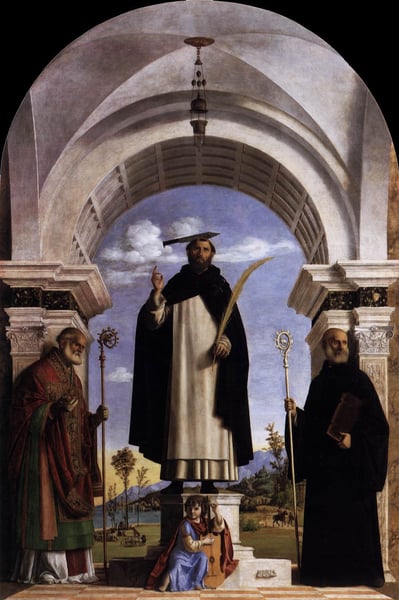
St. Peter Martyr with St. Nicholas of Bari, St. Benedict and an Angel Musician
Dettagli
Analisi esperta di St. Peter Martyr with St. Nicholas of Bari, St. Benedict and an Angel Musician di Cima da Conegliano
Stile: High Renaissance · Genere: religious painting
Expert Analysis: “St. Peter Martyr with St. Nicholas of Bari, St. Benedict and an Angel Musician” by Cima da Conegliano
This work exemplifies the core tenants of High Renaissance religious painting through its serene harmony, balanced composition, and refined naturalism. Cima da Conegliano, a Venetian master active at the turn of the 16th century, is celebrated for fusing the devotional clarity of earlier Quattrocento art with the emerging High Renaissance ideals of spatial unity and humanistic grace.
Significance within the High Renaissance Style
-
Composition & Symmetry: The grouping of four figures—St. Peter Martyr (identifiable by his Dominican habit and the wound on his head), St. Nicholas of Bari (often shown with three golden balls or a bishop’s miter), St. Benedict (in black monastic robes), and an angel musician—reflects the High Renaissance preference for a stable, pyramidal arrangement. Cima positions the figures in a calm, frontal plane, creating a sense of timeless order that invites contemplation rather than dramatic narrative.
-
Integration of Landscape: A hallmark of Cima’s work is the luminous, pastoral landscape that extends behind the saints. Here, the soft hills, distant blue mountains, and delicate trees are not mere backdrops but integral to the painting’s meditative mood. This use of a unified, atmospheric landscape—bathed in the cool, clear light typical of Venetian painting—places the sacred figures in a believable, earthly setting, a key innovation of the High Renaissance.
-
Devotional Clarity & Symbolism: Each saint is rendered with distinct attributes (St. Peter Martyr’s martyr’s palm, St. Nicholas’s bishop’s crozier, St. Benedict’s book), ensuring the painting functions as a clear aid to prayer. The inclusion of an angel musician, often a symbol of heavenly harmony, adds a subtle musical and celestial dimension. Cima’s figures are serene, with gentle expressions and naturalistic drapery that falls in soft folds, avoiding the stiff hieraticism of earlier periods.
-
Venetian Colorism: Unlike the Florentine emphasis on disegno (line and drawing), Cima employs the Venetian tradition of colore—rich, warm pigments applied in translucent glazes. The deep reds, blues, and whites of the robes, contrasted with the soft flesh tones and the angel’s golden hair, create a visually sumptuous yet spiritually elevating effect.
Conclusion
This painting stands as a refined example of how High Renaissance religious art balanced humanism with piety. Cima da Conegliano’s work bridges the early Renaissance’s focus on meticulous detail and the High Renaissance’s pursuit of idealized beauty, harmony, and spatial coherence. Its significance lies in its ability to convey sacred narrative through peaceful, balanced composition and a deeply felt sense of the divine presence within the natural world—a hallmark of the period’s highest aspirations.
Museum / Gallery
Visivamente simili
20 opere con composizione e palette affini
St. Peter Enthroned with Saints
Cima da Conegliano
Sts Thomas Aquinas and Flavian, Sts Peter the Martyr and Vitus
Lorenzo Lotto
Saint Dominic of Guzmán
Claudio Coello
Altarpiece of St. Vincent Ferrer
Domenico Ghirlandaio
Polyptych of San Vincenzo Ferreri
Giovanni Bellini
St. Thomas in Glory between St. Mark and St. Louis of Toulouse
Vittore Carpaccio
Apparition of the Virgin and Child to Saint Ubald of Gubbio, Who Points to the City of Pesaro
Palma il Giovane
Altar of Recanati polyptych, the left wing: St. Thomas Aquinas and St. Flavian
Lorenzo Lotto
St. Augustine
Piero della Francesca
Perugia Altarpiece (left panel)
Fra Angelico
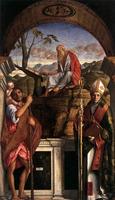
St. Jerome, St. Christopher and St. Augustine
Giovanni Bellini
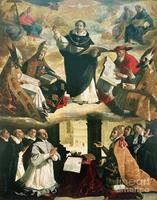
The Apotheosis of Saint Thomas Aquinas
Francisco de Zurbaran
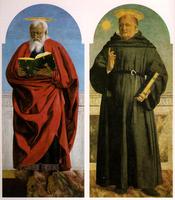
St. John the Evangelist and St. Nicholas of Tolentino
Piero della Francesca
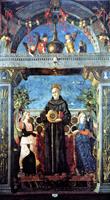
St. Bernardine of Siena with the Angels
Andrea Mantegna
St. Thomas Aquinas
Fra Angelico
Saint Catherine of Siena receiving the stigmata between Saints Benedict and Jerome (detail)
Domenico Beccafumi
Madonna with Child Jesus, Saint Maternus and Saint Anthony of Padua
Antonio Paoletti
St. Augustine Altarpiece (right wing)
Luca Signorelli
Saint Vincent Ferrer
Vicente Juan Masip
Saint Catherine of Siena receiving the stigmata between Saints Benedict and Jerome (detail)
Domenico Beccafumi