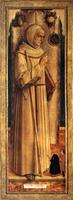
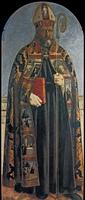
The Polyptych of San Vincenzo Ferreri by Giovanni Bellini stands as a pivotal work within the Early Renaissance tradition, marking a decisive shift from the lingering Gothic sensibility toward the naturalism and humanism that define the period. As a religious painting, this multi-panel altarpiece—structured as a polyptych—serves both a devotional and narrative function, typical of the era’s church commissions.
Its significance lies in Bellini’s ability to unify the separate panels through a coherent spatial and emotional atmosphere, moving beyond the flat, gold-ground icons of the preceding century. Bellini’s treatment of light, color, and landscape (where present) introduces a new sense of atmospheric depth, while the saints and central figures of San Vincenzo Ferreri are rendered with a soft, almost luminous humanity. This humanization of sacred subjects—conveyed through gentle modeling, expressive faces, and naturalistic drapery—reflects the Early Renaissance’s core goal: making the divine accessible and relatable.
Additionally, the polyptych format itself demonstrates a transitional moment: Bellini retains the traditional altarpiece structure but infuses it with a unifying perspective and a delicate tonal harmony that foreshadows the High Renaissance. In this work, he synthesizes the linear precision of his brother-in-law Andrea Mantegna with the richer, more painterly approach that would later define Venetian art. The Polyptych of San Vincenzo Ferreri is thus not only a masterpiece of religious iconography but a foundational statement of Bellini’s role in reshaping the altarpiece into a vehicle for spiritual contemplation through naturalistic beauty.