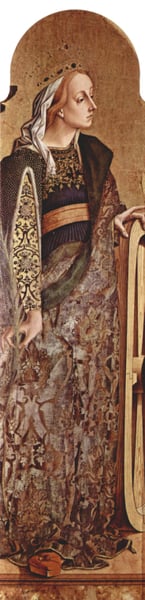
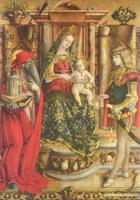
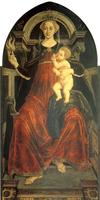
An expert analysis of Saint Catherine of Alexandria by Carlo Crivelli must be grounded solely in the given facts—Early Renaissance style and religious painting genre—and focus on what makes the work significant within that context.
Crivelli’s contribution to the Early Renaissance is distinct for its fusion of late Gothic decorative splendor with the nascent Renaissance interest in naturalistic detail and spatial clarity. In this religious painting, Saint Catherine is depicted with her iconic attributes (the wheel and martyr’s palm), but Crivelli elevates the composition through meticulous linear precision and a jewellike surface. The significance lies in how he retains the gold-ground tradition of medieval altarpieces while introducing a heightened sense of texture, volume, and emotional intensity—characteristics that anticipate the High Renaissance. The work exemplifies Crivelli’s unique position within the period: a conservative artist who nonetheless advanced Renaissance naturalism through his obsessive attention to ornament, fabric patterns, and subtle modeling of the saint’s face, creating an effect of both divine elegance and human presence. This duality makes the painting a key example of the transitional nature of the Early Renaissance, where symbolic iconography meets burgeoning realism.