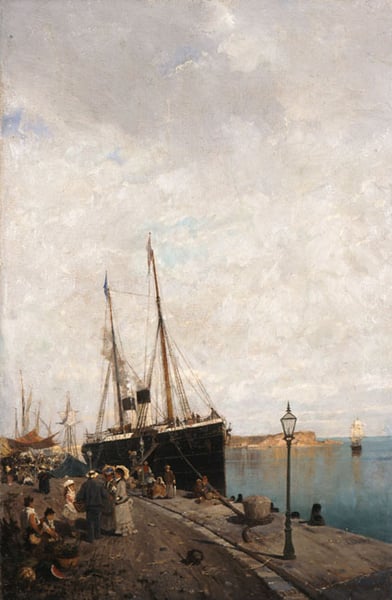
Konstantinos Volanakis sanatçısının At the Jetty eseri hakkında uzman analizi
Tarz: Realism · Tür: marina
Expert Analysis of "At the Jetty" by Konstantinos Volanakis
Konstantinos Volanakis (1837–1907) is widely regarded as the father of Greek marine painting, and "At the Jetty" stands as a quintessential example of his realist mastery within the marina genre. Executed in the hallmark style of 19th-century Realism, the work transcends mere topographical documentation to capture a living, breathing moment of coastal life.
Significance within Realism:
Volanakis adopted the core tenets of Realism—objective observation, attention to everyday subjects, and meticulous rendering of light and atmosphere—while infusing them with a distinctly Mediterranean sensibility. Rather than idealizing the sea, he depicts it as a working environment: the jetty is not a romantic ruin but a functional structure, likely in a Greek port such as Piraeus or Syros. The composition balances human activity (fishermen, dockworkers, or passengers) with the natural elements (water, sky, sunlight), reflecting Realism’s commitment to portraying ordinary life without dramatic artifice. The careful handling of reflections on the water and the subtle gradations of light in the sky demonstrate Volanakis’s technical debt to European Realists—particularly the Barbizon school and the Munich School where he trained—while asserting his own observational rigor.
Significance within the Marina Genre:
As a marina, "At the Jetty" elevates the seascape from a simple landscape subset to a narrative stage. Volanakis rejects the stormy, sublime seascapes popular in Romanticism (e.g., Turner or Aivazovsky) in favor of quiet, luminous harbor scenes. The jetty itself becomes a threshold between land and sea, human endeavor and nature’s vastness. The artist’s precise brushwork captures the texture of weathered wood, the shimmer of calm water, and the hazy horizon—all rendered with a palette of blues, grays, and warm earth tones that evoke the specific light of the Aegean. This approach aligns with the broader 19th-century trend toward plein-air observation and truthful depiction of local environments.
Cultural and Historical Significance:
Volanakis’s work is seminal in Greek art history because he synthesized Western European Realist techniques with indigenous subject matter, forging a national school of marine painting. "At the Jetty" not only documents the maritime infrastructure of a rapidly modernizing Greece but also embodies the nation’s enduring relationship with the sea—an identity that became central to the modern Greek state. The painting’s quiet authority lies in its refusal to sentimentalize; it presents the sea and its adjacent structures as they are, in a moment of tranquil equilibrium.
In summary, "At the Jetty" is significant for its masterful integration of Realist principles (truth to light, space, and everyday activity) into the marina genre, and for its role in defining a national artistic identity through the honest portrayal of Greek coastal life. Volanakis’s legacy as the preeminent Greek marine painter is epitomized here—calm, luminous, and deeply observant.
Görsel olarak benzer
İlişkili kompozisyon ve renk paletine sahip 20 eser
At the dock
Konstantinos Volanakis
Quay in Antwerp,
Louis Artan
Unloading cargo
Ioannis Altamouras
Moonlit harbour of Volos
Konstantinos Volanakis
Parade of the Navy. Imperial yacht Standart.
Ivan Vladimirov
Traffic on Stockholms Ström
Anna Palm de Rosa
The Port of Le Havre 2
Camille Pissarro
Imperial yacht ‘POLAR STAR’ of Nicholas II of Russia
Konstantin Kryzhitsky
Steamboats
Camille Pissarro
Honfleur. La Jetee
Eugene Boudin
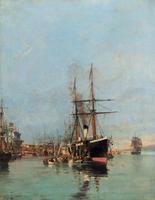
The port of Piraeus
Konstantinos Volanakis
Seascape
Ioannis Altamouras
Ship at Strömmen
Anna Palm de Rosa
Le Havre
Eugene Boudin
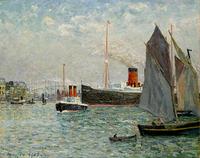
The Transatlantic leaving Port
Maxime Maufra
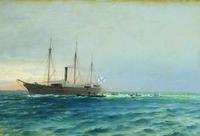
Grand Prince Constantine
Lev Lagorio
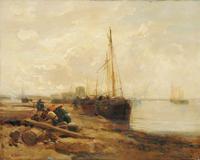
River Scene
James Webb

Harbour At Amsterdam
Cornelis Vreedenburgh
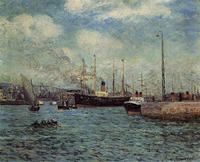
The Port of Havre
Maxime Maufra
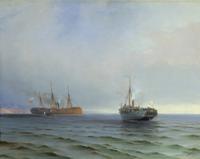
The capture of Turkish nave on Black sea
Ivan Aivazovsky