
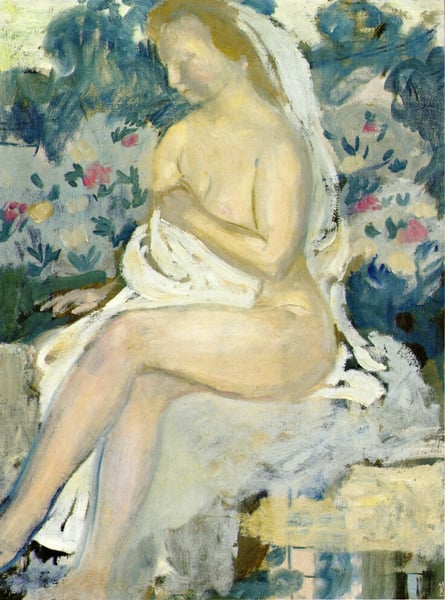
Expertenanalyse zu Maurice Deniss Bathsheeba, Blue Background
Stil: Post-Impressionism · Genre: religious painting
Expert Analysis: "Bathsheba, Blue Background" by Maurice Denis
Maurice Denis’s Bathsheba, Blue Background exemplifies the Post-Impressionist shift from naturalistic representation toward symbolic expression and decorative harmony. As a leading member of the Nabi movement, Denis championed the idea that art should be a visual equivalent of spiritual or emotional states rather than a mere imitation of nature. This religious painting—drawn from the Old Testament story of King David and Bathsheba—is significant for its radical departure from traditional narrative illustration.
Post-Impressionist Innovations The work is anchored in the Post-Impressionist emphasis on subjective color and simplified form. The “blue background” is not a realistic sky or interior but a saturated, almost abstract field that flattens pictorial depth, prioritizing mood over spatial illusion. Denis uses this monochrome backdrop to isolate Bathsheba as a timeless, almost iconic figure, her body reduced to elegant, flowing contours that echo the Nabi interest in Japanese print stylization. The composition deliberately avoids dramatic action; instead, it focuses on the quiet, contemplative tension of the moment, typical of Denis’s belief that art should be a “transfiguration of nature” filtered through the artist’s spirit.
Significance within Religious Painting Denis presents Bathsheba not as a seductress or victim, but as a calm, almost sacred presence. By stripping away anecdotal details (the letter, the rooftop voyeurism), he transforms the biblical episode into a meditation on grace, vulnerability, and the interplay of flesh and spirit. The rich blue—a color historically associated with the Virgin Mary—imbues the scene with solemnity, suggesting that Denis sees the human body as a vessel for the divine. This aligns with his broader mission as a Catholic artist: to renew religious art by merging symbolist introspection with modern decorative principles.
Legacy Bathsheba, Blue Background is a key example of how Post-Impressionism liberated religious painting from academic convention. It demonstrates Denis’s conviction that formal beauty—flat color, rhythmic line, and harmonious proportion—could convey sacred meaning more powerfully than literal storytelling. In doing so, it bridges the gap between 19th-century symbolism and the emerging modernist emphasis on abstraction, marking a turning point in how spiritual themes were rendered in the modern era.
Museum / Gallery
Visuell ähnlich
20 Werke mit ähnlicher Komposition und Farbpalette
La Baigneuse
Henri Manguin
Female nude
Joaquín Sorolla
Female nude
Umberto Veruda
Indulge
Umberto Veruda
Bather
Pierre-Auguste Renoir
After the Bath
Pierre-Auguste Renoir
Study Torso Sunlight Effect
Pierre-Auguste Renoir
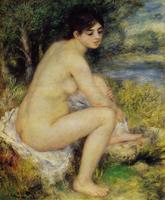
Seated Bather
Pierre-Auguste Renoir
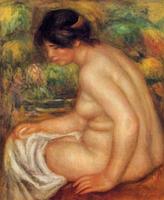
Seated Nude in Profile (Gabrielle)
Pierre-Auguste Renoir
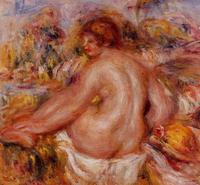
After Bathing, Seated Female Nude
Pierre-Auguste Renoir
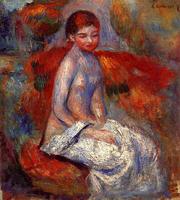
Nude Seated in a Landscape
Pierre-Auguste Renoir
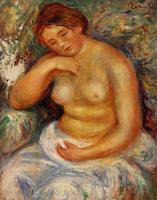
Seated Nude with a Bouquet
Pierre-Auguste Renoir
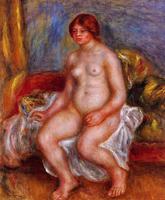
Nude Woman on Green Cushions
Pierre-Auguste Renoir
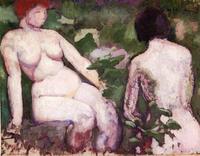
Two Nudes
Marcel Duchamp
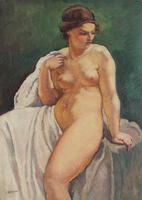
After Bath
Camil Ressu

Nude
Volodymyr Bondarenko
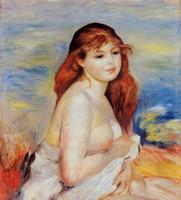
Bather
Pierre-Auguste Renoir
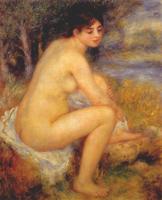
Nude in a landscape
Pierre-Auguste Renoir
Nude
Pierre-Auguste Renoir
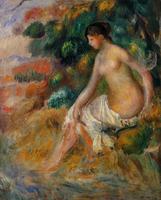
Nude in the Greenery
Pierre-Auguste Renoir