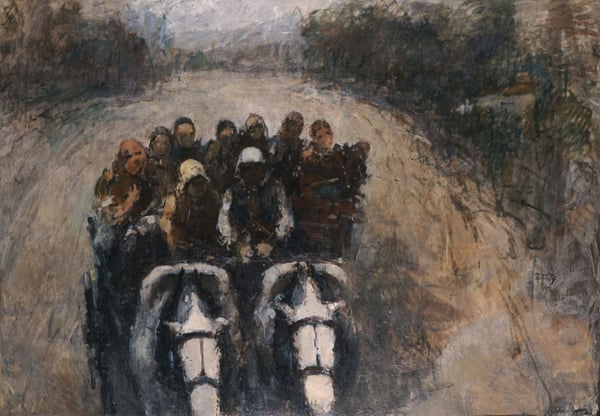
For the Grape Harvest (From the Life of the Gypsies)
Dettagli
Analisi esperta di For the Grape Harvest (From the Life of the Gypsies) di Theophrastos Triantafyllidis
Stile: Impressionism · Genere: genre painting
Expert Analysis: "For the Grape Harvest (From the Life of the Gypsies)" by Theophrastos Triantafyllidis
Theophrastos Triantafyllidis, a lesser-known yet vital figure in the spread of Impressionism beyond France, brings the movement’s core concerns—ephemeral light, atmospheric color, and the poetry of everyday life—to a subject rarely treated with such dignity in academic painting: the Romani (Gypsy) community. This work belongs to his series documenting the itinerant lives of marginalized groups, a genre-painting tradition that here is elevated by Impressionist technique.
Significance within Impressionism:
Triantafyllidis employs broken brushwork and a vibrant, sun-drenched palette to capture the fleeting instant of the grape harvest. The dappled light filtering through vineyard leaves and the shimmer of warm earth tones are rendered not with fine detail but with perceptual immediacy. This aligns with the Impressionist goal of recording sensory experience rather than narrative precision. The artist’s choice of a working-class, nomadic subject also reflects Impressionism’s democratic impulse—elevating the transient, the ordinary, and the peripheral to the status of high art.
Significance within genre painting:
While genre painting traditionally focused on domestic or peasant life from a safe, often sentimental distance, Triantafyllidis’s work offers a more ethnographic gaze. The title itself, From the Life of the Gypsies, frames the scene as a window into a specific cultural practice (grape harvesting) within a community historically exoticized or stereotyped. By treating the figures with the same luminous seriousness he would accord a bourgeois leisure scene, the artist challenges the hierarchical norms of 19th-century European painting. The composition—figures bent in labor, children at play, the timeless rhythm of the harvest—suggests both the specificity of Romani life and the universal human connection to the land.
Overall impact:
This painting is significant because it expands the Impressionist vision beyond its usual Parisian boulevards and leisure gardens into the rural margins of Greece and the Balkans. It demonstrates how Impressionism could become a tool for both formal experimentation and subtle social documentation, capturing the dignity of labor and the beauty of a culture often rendered invisible. Triantafyllidis’s work remains a crucial, if underrecognized, bridge between Western European Impressionism and the distinct visual cultures of the Eastern Mediterranean.
Museum / Gallery
Visivamente simili
20 opere con composizione e palette affini
The Plough Boy
Henry Herbert La Thangue
Workhorses in Montmartre
G H Breitner
From the top of the diligence
Giuseppe De Nittis
Three horses
Ivan Vladimirov
Dog Car
Henri de Toulouse-Lautrec
Under escort. On the muddy road
Ilya Repin
Harnessed Horses
Eugene Boudin
A Waggon and a Team of Horses
Rosa Bonheur
Horses Resting
Rudolf Schweitzer-Cumpana
Leaving Home
Henry Herbert La Thangue
Return from a Ball (Sleigh Ride)
Józef Chełmoński
A Road in Naples
Gustave Caillebotte
Winter
Karoly Ferenczy
Horse Team
Edvard Munch
HERANGALOPPIERENDE TROIKA
Franz Roubaud
Returning from the fair
Nicolae Grigorescu
White Wall
Kmetty János
Loading wood
Herman Johannes van der Weele
Study for the Fairman Rogers Four in Hand
Thomas Eakins
Spring Plowing
Edvard Munch