
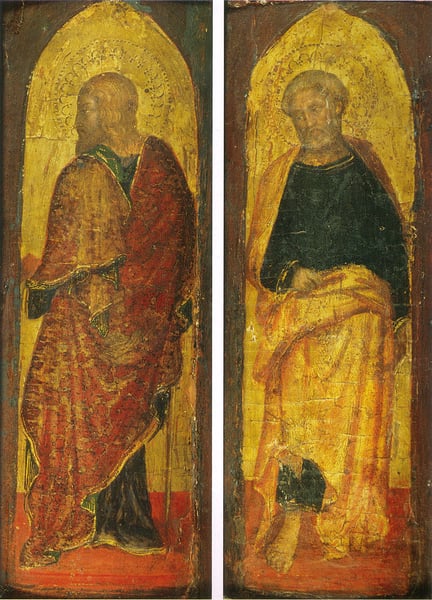
St. James the Greate and St. Peter, the polyptych Sandei Collection Berenson
Dettagli
Analisi esperta di St. James the Greate and St. Peter, the polyptych Sandei Collection Berenson di Gentile da Fabriano
Stile: International Gothic · Genere: religious painting
Expert Analysis: "St. James the Greater and St. Peter" (Polyptych, Sandei Collection Berenson) by Gentile da Fabriano
This work is a panel from a dismantled polyptych, attributed to the master of International Gothic, Gentile da Fabriano. Its significance lies in its embodiment of the courtly, decorative elegance that defines the International Gothic style at its zenith, while also showcasing Gentile’s unmatched skill in rendering sacred figures with a luxurious, human tenderness.
Stylistic Hallmarks of International Gothic Gentile da Fabriano was the leading painter of this style in early 15th-century Italy. This panel exemplifies two key features of International Gothic:
- Linear Elegance & S-Curve: St. James and St. Peter are depicted with elongated, graceful proportions and a subtle contrapposto that gives them a poised, almost dance-like rhythm. Their drapery falls in soft, cascading folds, creating a lyrical line that leads the eye upward—a signature of the Gothic love for flowing, ornamental form.
- Rich, Ornamental Detail & Gold: The background would originally have been resplendent with tooled gold leaf, creating a celestial, timeless space. The halos are likely embellished with punch-work patterns. St. Peter’s keys and St. James’s pilgrim staff are rendered with precise, precious metalwork, emphasizing the divine splendor over naturalistic setting.
Art Historical Significance The panel’s provenance—the Sandei Collection and attribution by connoisseur Bernard Berenson—confirms it as a key example of Gentile’s refined late style. Gentile was a master of the “soft style” (Weicher Stil), where religious figures become approachable yet majestic. Here, St. James (with his staff and scallop shell) and St. Peter (with keys) are not stern icons; their faces are softened with delicate shading, their gazes introspective. This humanization, combined with opulent surface decoration, made Gentile’s work immensely popular among wealthy patrons, especially in Florence and the papal court.
Genre and Narrative Impact As a religious painting, this panel served as a devotional image, likely part of a larger altarpiece. Its significance is not in dramatic action but in sacred presence. The pairing of two foundational apostles—St. Peter (the Church) and St. James (pilgrimage and martyrdom)—creates a theological dialogue. The gold ground removes them from earthly time, while the flowing Gothic lines connect them to the courtly aesthetic of the era’s ruling elite.
In summary, this work is a quintessential example of International Gothic’s synthesis of ornamental luxury, delicate figure style, and spiritual intimacy. It represents Gentile da Fabriano’s legacy as the painter who brought the last great flowering of medieval courtly art to Renaissance Italy.
Visivamente simili
20 opere con composizione e palette affini
St. Peter and St. Paul from Saint Sophia Cathedral in Novgorod
Orthodox Icons
Icon of Sts. Peter and Paul from Belozersk
Orthodox Icons
Presentation of Jesus at the Temple
Andrei Rublev
Six saints
Orthodox Icons
Saint James the Less
Orthodox Icons
Annunciation
Orthodox Icons
São Paulo E São João Baptista
Álvaro Pires de Évora
Thaddeus of Edessa (Thaddeus of the Seventy Disciples)
Orthodox Icons
Prophets. Jeremiah
Duccio
John the Baptist
Orthodox Icons
Icon of Apostles Andrew and Mark
Yov Kondzelevych

Lateral Panel
Giovanni da Milano
Harrowing to Hell
Orthodox Icons

Prophets. Isaiah
Duccio
Apostle Jacob
Duccio
St. Demetrius of Thessalonica
Andrei Rublev
Annunciation
Orthodox Icons
Theotokos of Saint Maksim's Vision
Orthodox Icons

Santo André E São Pedro
Álvaro Pires de Évora
Upcoming
Nicholas Roerich