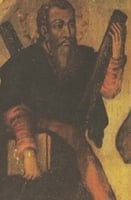
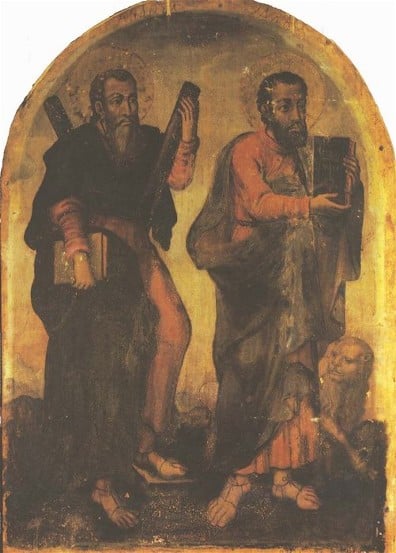
Analisi esperta di Icon of Apostles Andrew and Mark di Yov Kondzelevych
Stile: Baroque · Genere: religious painting, icon
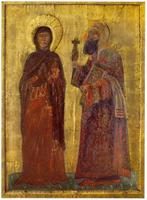
The "Icon of Apostles Andrew and Mark" by Yov Kondzelevych is a striking example of the Ukrainian Baroque synthesis—a deliberate fusion of Western European Baroque dynamism with the austere, spiritual conventions of Eastern Orthodox iconography. This work is significant not just as a religious image, but as a cultural bridge between artistic traditions in 17th–18th century Ukraine.
Key elements of significance:
-
Unique stylistic hybrid: Kondzelevych, a master of the Lviv icon-painting school, adapts Baroque devices such as dramatic chiaroscuro, volumetric modeling, and individualized facial expressions to the formal, frontal composition of an icon. This creates a rare tension: the saints retain their iconic, otherworldly holiness while simultaneously inhabiting a more tangible, human presence.
-
Emphasis on apostolic identity: The pairing of Andrew (patron of Ukraine and the Eastern Church) and Mark (Evangelist associated with Rome) is theologically loaded. In a period of religious and political tension between Catholic and Orthodox spheres, Kondzelevych’s treatment emphasizes unity—both apostles are given equal prominence, their gestures and attributes (Andrew’s X-shaped cross, Mark’s lion) rendered with Baroque theatricality but within a strictly hieratic, gold-ground framework.
-
Technical mastery: Kondzelevych’s use of rich tempera and gilding, combined with soft, painterly transitions in flesh tones, demonstrates a mature Baroque handling of light. The apostles’ robes cascade in rhythmic, almost sculptural folds, while their gazes engage the viewer in a direct, devotional dialogue—a hallmark of Counter-Reformation spirituality, here adapted to an Orthodox context.
-
Context of the Ukrainian Baroque: This icon exemplifies the broader cultural movement known as the Ukrainian or Cossack Baroque (c. 1650–1750), where Orthodox artists embraced Western forms to revitalize traditional icon painting. Kondzelevych’s work stands out for its refined balance: the figures remain hieratic and symmetrical, avoiding the extreme emotionalism of Western Baroque, yet they possess a new intensity of presence.
In sum, this icon is significant because it transcends simple categorization—it is neither a purely Byzantine icon nor a Western Baroque easel painting. Instead, it represents a nuanced, locally specific adaptation that speaks to the complex religious and artistic identity of early modern Ukraine.
Genere
Stile
Visivamente simili
20 opere con composizione e palette affini
Icon of Apostles Peter and Matthew
Yov Kondzelevych
Saint Peter and Saint Paul
Carlo Crivelli
St. James the Greate and St. Peter, the polyptych Sandei Collection Berenson
Gentile da Fabriano
The Descent Of The Holy Spirit
Yov Kondzelevych
Icon The Descent of the Holy Spirit
Yov Kondzelevych
Polyptych. Madonna and Child, Saint James the Great and Saint Henry (detail)
Ambrogio Bergognone
St. Paul
Masaccio
Lateral Panel
Giovanni da Milano
St. Michael and St. John
Álvaro Pires de Évora
Ascension.
Yov Kondzelevych
Sermon of Saint John the Baptist
Ivan Rutkovych
São Paulo E São João Baptista
Álvaro Pires de Évora
Polyptych. Madonna and Child, Saint James the Great and Saint Henry (detail)
Ambrogio Bergognone
Annunciation
Orthodox Icons
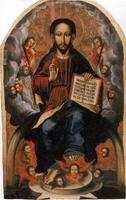
Icon of the Savior from the village of Horodyshche in Volhynia (late 17th century)
Yov Kondzelevych
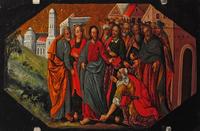
Christ Healing the Hemorrhaging Woman
Ivan Rutkovych
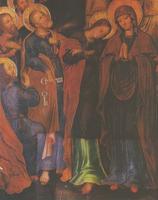
Fragment of the icon The Elevation of Christ into Heaven from the Maniava Hermitage iconostasis
Yov Kondzelevych
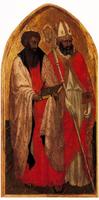
San Giovenale Triptych. Left panel
Masaccio
Upcoming
Nicholas Roerich
Scenes from the Life of St Thomas
Luca di Tommé