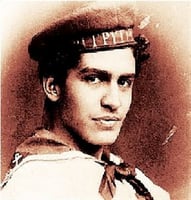
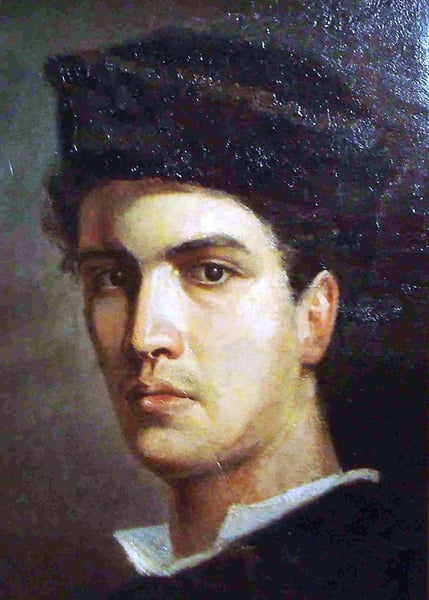
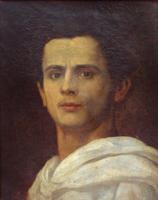
Self-Portrait
Analisi esperta di Self-Portrait di Ioannis Altamouras
Stile: Realism · Genere: self-portrait
Expert Analysis: "Self-Portrait" by Ioannis Altamouras
Ioannis Altamouras’s Self-Portrait stands as a compelling testament to the ideals of Realism—a movement that sought to depict subjects with unidealized, factual accuracy—while also offering a rare and intimate glimpse into the artist’s own identity. Painted within the latter half of the 19th century, this work is significant for several key reasons:
-
Mastery of Realist Technique: Altamouras demonstrates exceptional control over light, shadow, and texture. The self-portrait likely captures the sitter’s features with meticulous attention to naturalistic detail—the play of light on skin, the precise rendering of facial structure, and the honest portrayal of age or expression. This aligns with the Realist rejection of romanticized or academic idealization, favoring instead a truthful, almost documentary approach to human likeness.
-
Autobiographical Rarity: Altamouras died tragically young at age 26, leaving behind a limited body of work primarily focused on maritime themes. This self-portrait is one of the few known records of his own appearance, making it an invaluable biographical and historical artifact. It offers scholars and viewers a direct visual link to the artist himself—a raw, unmediated statement of his presence and self-perception.
-
Contribution to Greek Realism: As a Greek painter who studied in Athens and later in Denmark (at the Royal Danish Academy of Fine Arts), Altamouras helped bridge European Realist currents with Greek artistic identity. His self-portrait not only reflects the international Realist vocabulary—honest observation, subdued palette, and psychological depth—but also asserts the place of Greek artists within the broader 19th-century European art scene.
-
Psychological Depth and Modern Sensibility: Self-portraiture in Realism often transcends mere physical likeness to probe inner character. Altamouras’s gaze, posture, and setting likely convey a sense of introspection or quiet determination—hallmarks of the Realist interest in the ordinary, the earnest, and the unembellished human experience. This gives the work a proto-modern quality, anticipating later psychological portraits by artists like Courbet or even early Van Gogh.
In sum, Self-Portrait by Ioannis Altamouras is significant not only as a technical showcase of Realist principles but also as a poignant, rare window into the life of a promising artist cut short. It anchors Altamouras’s legacy within both Greek art history and the broader Realist movement, securing his place as a devoted observer of truth—both of the world around him and of himself.
Visivamente simili
20 opere con composizione e palette affini
Portrait of a Young Man
Daniele da Volterra
Portrait of a man
Orest Kiprensky
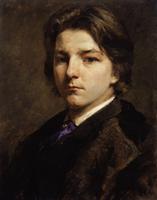
Self-portrait
Frank Holl
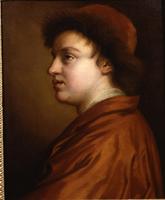
Charles Beale
Mary Beale
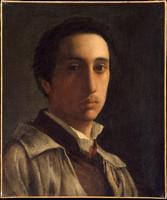
Self-Portrait
Edgar Degas
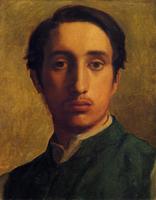
Degas in a Green Jacket
Edgar Degas
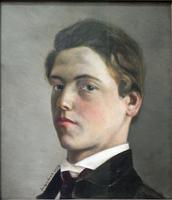
Selbstbildnis des Achtzehnjährigen
Wilhelm Leibl
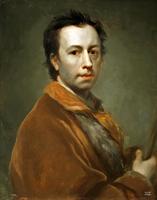
Self Portrait
Anton Raphael Mengs
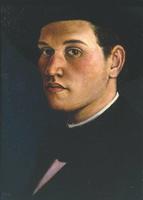
Self Portrait
C. R. W. Nevinson
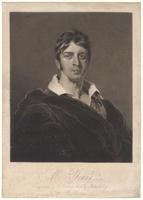
Charles Mayne Young
Charles Turner
Portrait of a Young Man
John Jackson
Self-portrait
Karl Ferdinand Sohn
Mama
Oleg Holosiy
Self-portrait
Henri Regnault
Portrait Of Miquel Llambías Adrover
Joan Brull
Self-portrait
Ernest Hébert
Albert de Belleroche
John Singer Sargent
Jessie Jay Burge
Abbott Handerson Thayer
Self-portrait
Jose Ferraz de Almeida Junior
A young man holding a butterfly
Pietro Paolini