
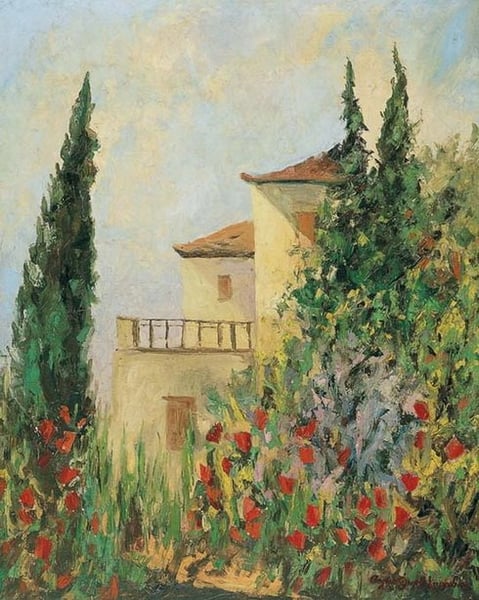
Cypress-House
Expertenanalyse zu Thalia Flora-Karavias Cypress-House
Stil: Impressionism · Genre: landscape
Expert Analysis: Cypress-House by Thalia Flora-Karavia
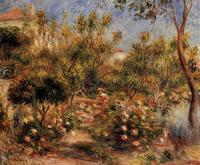
Thalia Flora-Karavia’s Cypress-House is a compelling example of how Impressionist principles were adapted to the Mediterranean landscape. Executed in the late 19th or early 20th century, the painting demonstrates the artist’s mastery of capturing fleeting effects of light and atmosphere, while also asserting a distinct Greek sensibility within the broader European Impressionist movement.
Stylistic Significance
True to Impressionist practice, Flora-Karavia employs broken, visible brushstrokes to render the interplay of sunlight and shadow. The cypress trees—a quintessential motif of the Greek countryside—are not meticulously detailed but suggested through dabs and dashes of green, blue, and violet, conveying their vertical thrust and the shimmering air around them. The “house” itself is treated as a patchwork of warm ochres, pinks, and cool grays, reflecting the changing light and the artist’s interest in optical perception rather than architectural precision.
Thematic and Cultural Significance
What makes Cypress-House particularly significant is its role in bridging European Impressionism with Greek modernism. Flora-Karavia, one of the few prominent female artists of her generation in Greece, studied in Munich and Paris, absorbing the latest avant-garde techniques. Yet she consistently applied them to local subjects—rural homes, coastal views, and everyday life—thus creating a uniquely Greek Impressionist vocabulary. In this work, the iconic cypress, long associated with Greek funerary and spiritual traditions, is transformed into a vehicle for pure visual sensation, stripping away symbolic weight in favor of perceptual immediacy.
Contribution to Impressionism
Within the context of Impressionism, Cypress-House stands out for its integration of characteristic Impressionist color theory—complementary blues and oranges creating vibrant shadows—with a composition that is both intimate and monumental. The verticality of the cypresses and the horizontal mass of the house create a strong, almost geometric structure, tempering the typical Impressionist emphasis on spontaneity with a Mediterranean sense of order. This balance of light, color, and form underscores Flora-Karavia’s role as a vital interpreter of Impressionism beyond its French origins, expanding the movement’s scope into new cultural landscapes.
Visuell ähnlich
20 Werke mit ähnlicher Komposition und Farbpalette
Algiers Landscape
Pierre-Auguste Renoir
Study from the South of France
Anna Katarina Boberg
Granada
John Singer Sargent
View of Fiesole
William Merritt Chase
Bordighera, the House of Gardener
Claude Monet
In the south of France
Konstantin Korovin
The Abandoned House
Paul Cezanne
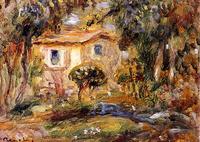
Landscape
Pierre-Auguste Renoir
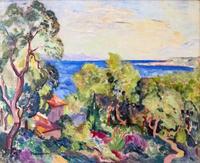
Le Golfe
Henri Manguin
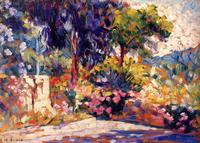
The Flowered Terrace
Henri-Edmond Cross
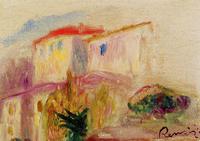
Le Poste at Cagnes (study)
Pierre-Auguste Renoir
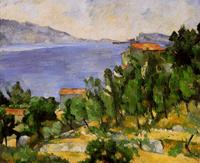
The Bay of L'Estaque from the East
Paul Cezanne
The Crimean landscape
Konstantin Bogaevsky
Beginning of Springtime
Kimon Loghi
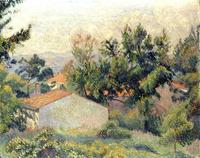
Le Brusq
Lucien Pissarro
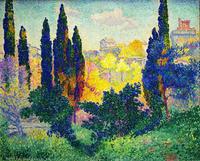
The Cypresses at Cagnes
Henri-Edmond Cross
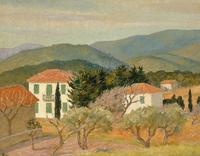
House below hill
Rupert Bunny
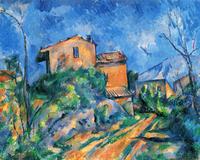
Maison Maria with a View of Chateau Noir
Paul Cezanne
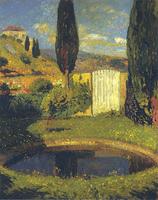
Garden at Labastide du Vert
Henri Martin
Young Woman in a Garden Cagnes
Pierre-Auguste Renoir