Expert analysis of Alekos Kontopoulos’s Gaia
Style: Abstract Art, Surrealism · Genre: abstract
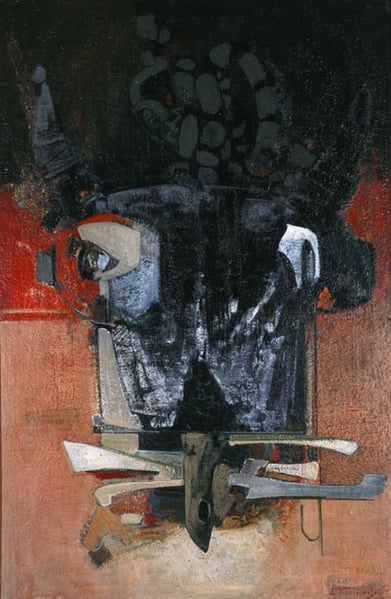
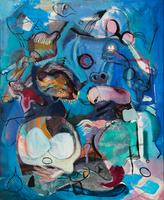
Alekos Kontopoulos’s Gaia stands as a compelling synthesis of Abstract Art and Surrealism, two movements that rarely coexist with such seamless intent. The title itself invokes the primordial Greek earth goddess, grounding the work in mythic resonance while the execution pushes toward pure form and subconscious expression.
Style & Technique:
As an abstract surrealist work, Gaia likely employs biomorphic shapes, floating organic forms, and a dreamlike spatial logic that blurs the boundary between landscape and inner vision. Kontopoulos combines the automatism of Surrealism—spontaneous, gestural marks intended to bypass rational control—with a distinctly abstract vocabulary of color fields, rhythmic lines, and non-representational structure. This fusion allows Gaia to evoke the generative, chaotic energy of the earth without resorting to literal depiction.
Significance within the Period:
Kontopoulos was a pivotal figure in post-war Greek modernism, a context in which Surrealism arrived relatively late but was adapted with a strong local sensibility. Gaia exemplifies how Greek artists reimagined European avant-garde movements through a lens of classical mythology and landscape memory. The work’s significance lies in its ability to make the abstract feel mythic: the viewer senses a vast, living entity—not a picture of earth, but an emanation of it.
Art Historical Contribution:
By merging the irrational impulses of Surrealism with the formal purity of Abstraction, Kontopoulos anticipated later developments in lyrical abstraction and Tachisme. Gaia is not merely an exercise in style; it is a philosophical statement—a modern, nonverbal hymn to the chthonic forces that Surrealists sought in the unconscious and Abstract artists found in pure color and line. The painting thus occupies a rare space where primordial archetype and avant-garde syntax converge.
Genre
Visually similar
20 works with related composition and palette
Bull's head on the table
Pablo Picasso
Mascarados de Pirenópolis XIV
Julio Pomar
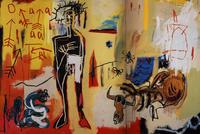
Poison Oasis
Jean-Michel Basquiat
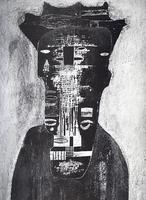
Untitled
Zdzislaw Beksinski
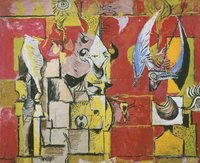
Study for ‘Origins of Land’ (recto)
Graham Sutherland
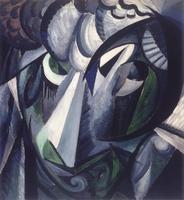
Head
Oleksandr Bogomazov
Still life with skull of ox
Pablo Picasso
Green Tree Form
Graham Sutherland
Untitled
Zdzislaw Beksinski
Hombre Toro, Leon de Oro
Ramon Oviedo
Face and Figure
Christo Coetzee
Design in Nature
Max Ernst
The She-Wolf
Jackson Pollock
Organismo umano
Enrico Prampolini
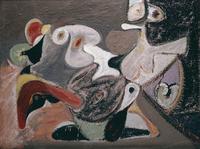
Image in Khorkom
Arshile Gorky
Bullfighting Scene (The picador raised)
Pablo Picasso
Flight of the Spectre
Theodoros Stamos
The Stormy Sea
Alma Woodsey Thomas
Composition surréaliste
Endre Rozsda
Shaman
Ben Vollers