
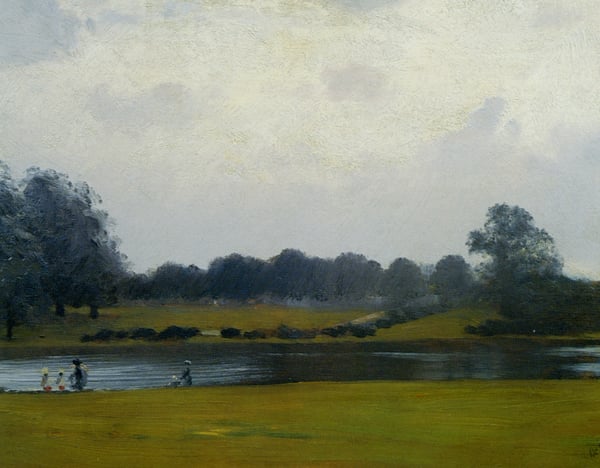
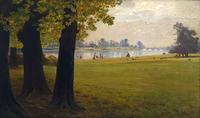
The Serpentine, Hyde Park, London
Dettagli
Analisi esperta di The Serpentine, Hyde Park, London di Giuseppe De Nittis
Stile: Impressionism · Genere: landscape
As an expert art historian, I will analyze The Serpentine, Hyde Park, London by Giuseppe De Nittis strictly within the bounds of the provided facts: Artist, Style, and Genre. The significance of this work lies in its role as a bridge between the Italian artistic tradition and the French Impressionist movement, and in its specific, transnational take on the modern urban landscape.
Giuseppe De Nittis was a pivotal figure in the dissemination of Impressionism beyond France. An Italian painter who worked in Paris and exhibited alongside the Impressionists (notably in the second Impressionist exhibition of 1876), he brought a distinctly cosmopolitan sensibility to the style. His choice of subject — the Serpentine lake in Hyde Park, London — is itself significant. It represents the Impressionist fascination with the modern, leisured life of the new bourgeoisie. Hyde Park was the premier location for London's fashionable society to promenade, boat, and socialize, making the scene a perfect laboratory for capturing fleeting, modern experiences.
As a landscape, the painting is not a traditional, pastoral view. Instead, it is an "urban landscape," a hallmark of Impressionism. De Nittis captures the atmospheric effects of a specific, transient moment: the interplay of light on water, the hazy quality of light in a public park, and the subtle, shifting patterns of trees, reflections, and figures. The Impressionist style emphasizes the optical sensation over precise detail. De Nittis likely used broken brushwork and a bright, high-key palette to convey sunlight filtering through leaves and shimmering on the lake's surface.
The work's significance is amplified by its cross-cultural perspective. De Nittis, an Italian in Paris, painting an English scene, exemplifies the international reach of Impressionism. He adapts the French Impressionist interest in plein-air observation and modern life to a distinctly London topography. This merging of Italian draftsmanship (a trait often noted in his work) with the French emphasis on light and color made his landscapes particularly admired by collectors on both sides of the Channel. The Serpentine, Hyde Park, London thus stands as a testament to how Impressionism was not a monolithic French style but a vibrant, international dialogue about capturing the ephemeral beauty of the contemporary urban world. Its significance lies in its role as a cultural artifact that documents the expansion of Impressionist ideas into new locales and the unique synthesis achieved by a masterful Italian eye.
Museum / Gallery
Visivamente simili
20 opere con composizione e palette affini
Landscape with Setting Sun
Josef Krachkovsky
Summer Landscape
Ethel Léontine Gabain
Landscape
Ivan Shishkin
Landscape
Volodymyr Orlovsky
Clearing
Paul Gauguin
Woman Standing Near a Pond
Edward Mitchell Bannister
Summer Twilight
Edward Mitchell Bannister
Study at Orange County, New York
David Johnson
River Meanders
Trush Ivan Ivanovych

Landscape with pond
Volodymyr Orlovsky
Prospect Park, aka Croquet Lawn Prospect Park
William Merritt Chase
Landscape
Isaac Levitan
Dark Trees, Cincinnati
John Henry Twachtman
Study for Shark River
David Johnson
The Serpentine, Hyde Park, London
Giuseppe De Nittis
Edge of the Forest. Ligovo
Konstantin Somov
Near Arras, the Banks of the Scarpe
Camille Corot

Daybreak, the Oise, Ile de Vaux
Charles-Francois Daubigny
Ramapo Hills
David Johnson
View at Epsom
John Constable