Expertenanalyse zu Grant Woods Daughters of Revolution
Stil: Regionalism · Genre: portrait
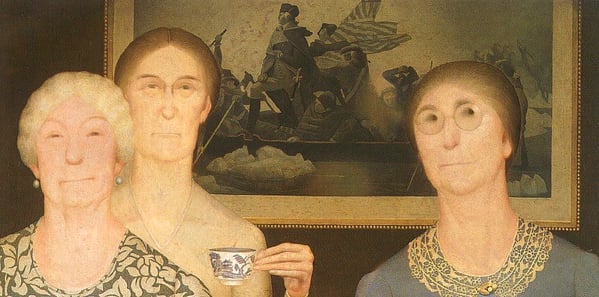
Grant Wood's Daughters of Revolution (1932) is a masterpiece of Regionalism, the American artistic movement that turned away from European abstraction to celebrate—and often critique—authentic, often Midwestern, life. While the genre is a formal group portrait, the work functions as a biting social satire, making it significant for its layered commentary on class, patriotism, and exclusion.
Stylistic Significance within Regionalism: Wood employs the hallmarks of Regionalism—sharp clarity, meticulous detail, and a slightly stiff, almost primitive precision—to ground the scene in a recognizable American reality. The three women are depicted with photographic exactness, their rigid postures and identical pearl necklaces echoing the order and propriety they represent. Yet Wood subverts the movement’s typical celebration of rural virtue by turning his lens on an urban, elite institution. The painting’s cold, deliberate style mirrors the cold, exclusionary mindset of its subjects.
Iconography and Satirical Impact: The painting’s genius lies in its visual argument. The women stand before Emanuel Leutze’s heroic Washington Crossing the Delaware (1851), a quintessential symbol of revolutionary sacrifice. By placing themselves in front of this canvas, the Daughters claim that patriotic legacy as their own. However, Wood undercuts this by having them block the viewer’s view of George Washington himself—a subtle but devastating critique: these gatekeepers of heritage obscure the very ideals they profess to uphold. The pristine teacup on the doily hints at genteel tea parties, but the women’s expressions are stern, unwelcoming. The painting was inspired by Wood’s real-life rejection from the DAR for his murals (on grounds that his stepmother was not a Daughters member), adding a personal barb.
Significance to Period and Art History: Daughters of Revolution is a landmark of Regionalism’s capacity for social critique. Unlike the romanticized farms of Thomas Hart Benton, Wood used the movement’s accessible style to expose hypocrisy in American identity. It stands as a powerful early example of how regional art could engage with national politics—questioning who gets to define patriotism. The painting remains a touchstone for its concise, biting indictment of hereditary privilege and the weaponization of history, while still achieving the compositional harmony and precise detail that define Wood’s finest work.
Museum / Gallery
Visuell ähnlich
20 Werke mit ähnlicher Komposition und Farbpalette
Two women
Tsuguharu Foujita
The Sisters
Fernando Botero
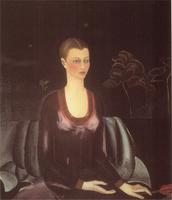
Portrait of Alicia Galant
Frida Kahlo
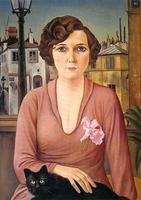
Marcella
Christian Schad
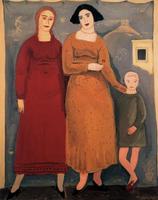
By the Outdoor Photographer
Yiannis Moralis
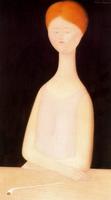
Untitled
Antonio Bueno
Two Women
Le Pho
Untitled
Antonio Bueno
Unknown
Christian Schad
Meditazione
Mario Tozzi
The Artist's Wife
Horace Pippin
Maria and Annunziata 'from the Harbour'
Christian Schad
Lotte
Christian Schad
Portrait of N.I. Zelenskaya
Boris Kustodiev
Group of Artists
Marie Laurencin
Woman with a Parrot
Fernando Botero
Girl in a Green Blouse
Amedeo Modigliani
Before the Singing
Antonio Donghi
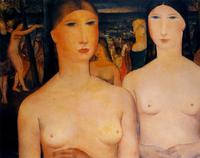
Girls by the sea
Paul Delvaux
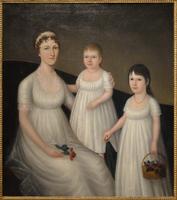
Grace Allison McCurdy and Her Daughters
Joshua Johnson