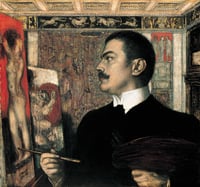
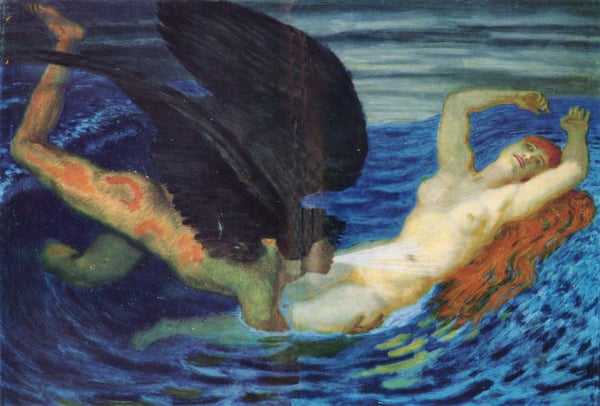
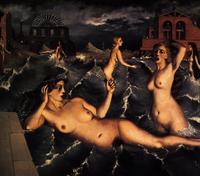
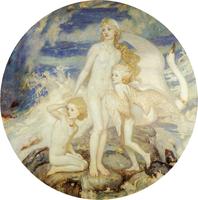
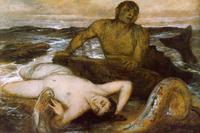
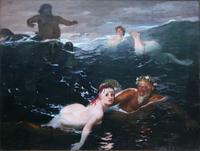
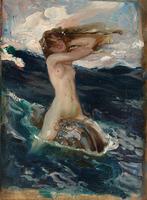
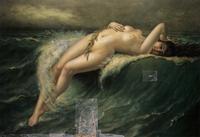
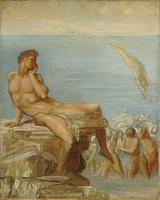
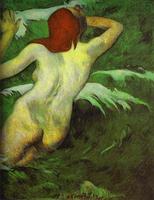
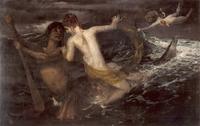
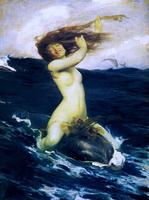
Franz Stuck’s “Wind and Wave” is a striking embodiment of Symbolist ideals, transforming natural forces into a potent allegorical tableau. Within the Symbolist movement, artists rejected mere visual realism to evoke inner states, myths, and cosmic moods. Stuck achieves this by personifying the wind and wave not as passive landscapes but as active, almost mythological presences—suggesting the turbulent union of elemental power and human emotion. The work’s significance lies in its fusion of dynamic, often erotic energy with a controlled, decorative composition, characteristic of Stuck’s Munich Secession style. The allegory operates on multiple levels: it can be read as a struggle between opposing forces, a metaphor for fate, or a sensory exploration of dread and ecstasy. In the context of Symbolism, “Wind and Wave” stands out for its visceral immediacy, using chiaroscuro and fluid line to make an abstract idea feel tangible and emotionally charged.