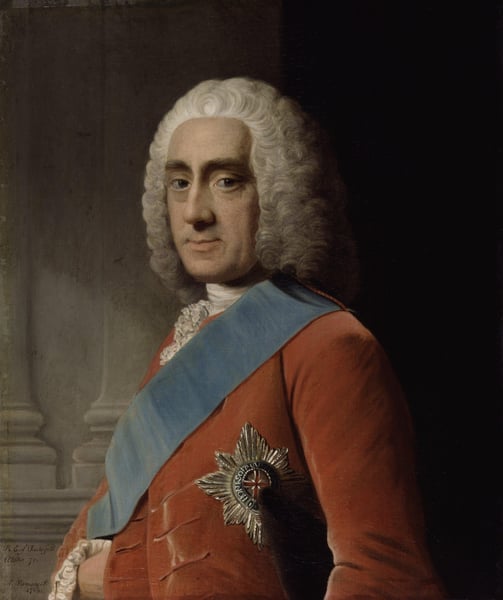
Philip Dormer Stanhope, 4th Earl of Chesterfield
Allan Ramsay sanatçısının Philip Dormer Stanhope, 4th Earl of Chesterfield eseri hakkında uzman analizi
Tarz: Rococo · Tür: portrait
Expert Analysis of "Philip Dormer Stanhope, 4th Earl of Chesterfield" by Allan Ramsay
As a Rococo portrait, Allan Ramsay’s depiction of the 4th Earl of Chesterfield stands as a refined exemplar of the style’s core values: elegance, intimacy, and understated sophistication. The work’s significance lies in how it marries the lighter, more personal aesthetic of Rococo with the traditional gravitas of aristocratic portraiture, while also reflecting the intellectual character of its sitter.
Context and Stylistic Significance Within the Rococo movement—which flourished in France and England during the mid-18th century—portraits often moved away from the formal grandeur of Baroque towards a softer, more conversational tone. Ramsay, one of Britain’s foremost portraitists of the period, was particularly adept at this. In this portrait, the emphasis on grace, refined palette, and subtle play of light and shadow aligns perfectly with Rococo’s preference for charm over overt drama. The composition likely focuses on the Earl’s face and bearing, with a restrained yet elegant background that does not overwhelm the subject, allowing the viewer an intimate glimpse into the personality of a famous statesman and man of letters.
Subject and Cultural Relevance Philip Dormer Stanhope (1694–1773) was not only a powerful politician but also a celebrated writer, best known for his letters to his son on manners and education. Ramsay’s portrait thus captures the ideal of the honnête homme—a cultivated, witty, and polished individual—perfectly embodying the Rococo spirit of civilized refinement. The painting’s significance also stems from its role in cementing Ramsay’s reputation as a portraitist who could imbue state portraits with genuine psychological depth, setting a standard for British portraiture that bridged Rococo elegance and the emerging sensibility of the Enlightenment.
In sum, this artwork is significant for its masterful synthesis of Rococo stylistic traits—delicate touch, intimate scale, and graceful composition—with the intellectual legacy of its sitter, making it a key example of how the genre of portraiture evolved to reflect both personal character and broader cultural ideals in the 18th century.
Görsel olarak benzer
İlişkili kompozisyon ve renk paletine sahip 20 eser
Prince James Francis Edward Stuart
Anton Raphael Mengs
Portrait of Nikolay Borisovich Samoylov
Carl Wenig
Russian general Mikhail Krechetnikov
Dmitry Levitzky
Portrait of King George III
Allan Ramsay
Portrait of George John Spencer, 2nd Earl Spencer
John Singleton Copley
Prince Xavier of Saxony
Maurice Quentin de La Tour
Portrait of Louis XVI, King of France and Navarre
Joseph Duplessis
Charles Louis Fouquet, Duke of Belle Isle
Maurice Quentin de La Tour
Portrait of Charles Hanbury Williams
Anton Raphael Mengs
Portrait of Frederick, Prince of Wales
Jean-Étienne Liotard
Portrait of Louis, Dauphin of France
Jean-Étienne Liotard
George Macartney, 1st Earl Macartney; Sir George Leonard Staunton, 1st Bt
Lemuel Francis Abbott
Portrait of Don Luis De Borbon Infante of Spain
Anton Raphael Mengs
Portrait of Adam Vasilevich Olsufyev
Carl-Ludwig Johann Christineck
Louis Philippe Rigaud De Vaudreuil
Claude Arnulphy
Portrait of an Unknown Man (possibly General Hugh Warburton, 1695–1771)
Henry Pickering
Portrait of René Frémin, Sculptor
Maurice Quentin de La Tour
August II the Strong
Marcello Bacciarelli
Kazimierz Raczyński
Pompeo Batoni
Sir Andrew Mitchell
Allan Ramsay