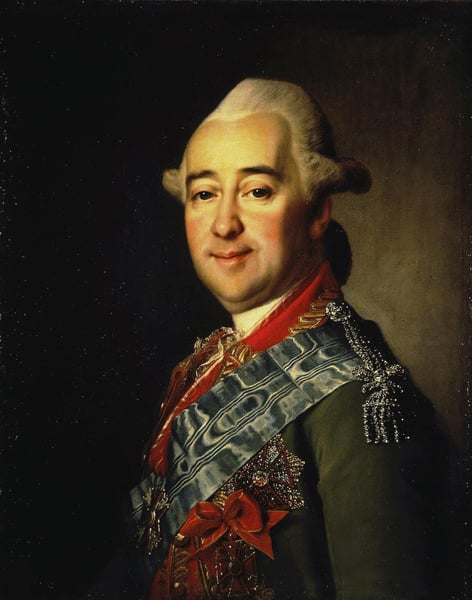
Expert analysis of Dmitry Levitzky’s Russian general Mikhail Krechetnikov
Style: Rococo · Genre: portrait
As an expert art historian, I can provide an analysis based strictly on the provided facts: the artwork is Russian general Mikhail Krechetnikov by Dmitry Levitzky, painted in the Rococo style and of the portrait genre.
Significance within Rococo and the Portrait Genre
Dmitry Levitzky is one of the most important Russian portraitists of the 18th century, and this work exemplifies the distinctive adaptation of Rococo aesthetics in Russian art. While European Rococo often focused on aristocratic leisure, playful mythology, and decorative intimacy, Levitzky infused the style with a sense of dignified realism and psychological depth, particularly suited to portraiture.
In Russian general Mikhail Krechetnikov, the Rococo influence is visible in the likely soft, pastel-like palette, fluid brushwork, and the emphasis on elegance and refinement—even in a military subject. The general is not portrayed with stark martial severity; instead, the Rococo approach suggests grace, poise, and a cultivated air, aligning with the period’s preference for charm over overt power. Levitzky’s skill lies in balancing the ornamental lightness of Rococo (delicate fabrics, subtle lighting, and perhaps a decorative background) with a direct, characterizing likeness of the sitter.
The significance of this portrait lies in its role as a bridge: it brings the sophistication of Western European Rococo into Russian portraiture while maintaining a unique national identity. Levitzky elevates the general from a mere military figure to a cultured aristocrat, reflecting the broader 18th-century Russian court’s adoption of European tastes. The work thus stands as a key example of how Rococo was not simply imported but transformed—used to convey both personal identity and social standing in a rapidly modernizing empire.
Visually similar
20 works with related composition and palette
Prince Xavier of Saxony
Maurice Quentin de La Tour
Portrait of the Elector Karl Theodor of the Palatinate
Pompeo Batoni
Portrait of Louis, Dauphin of France
Jean-Étienne Liotard
Portrait of Don Luis De Borbon Infante of Spain
Anton Raphael Mengs
Alexandr Viazemsky
Carl-Ludwig Johann Christineck
Portrait of Louis XVI, King of France and Navarre
Joseph Duplessis
Louis of France, Dauphin, son of Louis XV
Maurice Quentin de La Tour
Portrait of George John Spencer, 2nd Earl Spencer
John Singleton Copley
Portrait of Nikolay Borisovich Samoylov
Carl Wenig
Portrait of Prince G.G. Orlov
Carl-Ludwig Johann Christineck
Paul I
Vladimir Borovikovsky
Portrait of Adam Vasilevich Olsufyev
Carl-Ludwig Johann Christineck
Portrait of Fedor Orlov
Dmitry Levitzky
Portrait of D. P. Troschinsky
Vladimir Borovikovsky
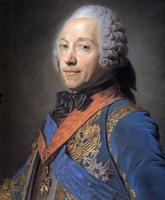
Charles Louis Fouquet, Duke of Belle Isle
Maurice Quentin de La Tour
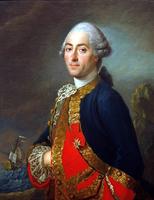
Louis Philippe Rigaud De Vaudreuil
Claude Arnulphy
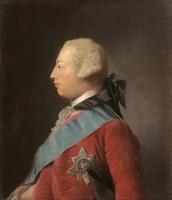
Portrait of King George III
Allan Ramsay
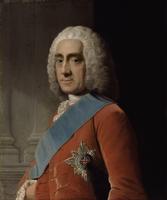
Philip Dormer Stanhope, 4th Earl of Chesterfield
Allan Ramsay
Sir John Dick
Gilbert Stuart
Portrait of Gavrila Romanovich Derzhavin
Vladimir Borovikovsky