Expertenanalyse zu William Holman Hunts The Ponte Vecchio, Florence
Stil: Romanticism · Genre: cityscape
Expert Analysis: "The Ponte Vecchio, Florence" by William Holman Hunt
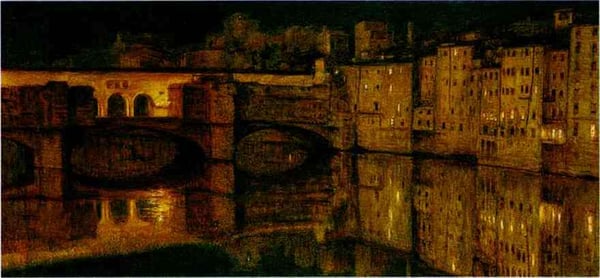
Within the framework of Romanticism, William Holman Hunt’s cityscape of Florence’s iconic bridge achieves significance through its fusion of meticulous naturalism with the Romantic era’s deep reverence for history, atmosphere, and the sublime character of urban spaces. Although Hunt is best known as a founding member of the Pre-Raphaelite Brotherhood, the supplied classification of this work as Romanticism places it within a movement that prized emotional resonance, the picturesque, and the poetic interplay of light and shadow.
Key aspects of its Romantic significance:
-
Historical and emotional evocation: The Ponte Vecchio, with its centuries-old shops and storied past, is not merely a topographical record but a vessel for Romantic nostalgia. Hunt captures the bridge as a living artifact, inviting viewers to contemplate the passage of time, the endurance of human craftsmanship, and the layered history of Florence—a city beloved by Romantic travelers and artists alike.
-
Atmospheric luminosity: Romantic cityscapes often used light to heighten mood. Hunt’s handling of the Arno’s reflections and the warm tones of the bridge’s stonework creates a tranquil yet charged atmosphere, emphasizing the sublime beauty found in everyday urban views. The interplay of shadowed archways and sunlit facades guides the eye and evokes a sense of quiet discovery.
-
Detailed naturalism as Romantic precision: Though Romanticism sometimes prioritized dramatic emotion over exacting detail, Hunt’s background in Pre-Raphaelite observation imbues this cityscape with an almost scientific fidelity—yet this precision serves the Romantic goal of making the familiar extraordinary. Every brick and ripple is rendered with devotion, transforming a tourist landmark into a site of personal, contemplative experience.
-
Genre as a vehicle for the sublime: The cityscape genre, often overlooked in favor of wild landscapes, is elevated here. Hunt demonstrates that even a crafted urban environment can provoke the Romantic awe typically reserved for mountains or storms. The bridge becomes a threshold between the human and the eternal, the mundane and the transcendent.
In summary, "The Ponte Vecchio, Florence" is significant as a Romantic cityscape that marries Hunt’s characteristic exactness with the movement’s core values: a deep historical consciousness, a poetic treatment of light, and the elevation of a familiar urban subject into a meditation on time, beauty, and human legacy.
Visuell ähnlich
20 Werke mit ähnlicher Komposition und Farbpalette
A View of the River Arno, Towards Ponte Vecchio in Florence
Lili Elbe
Ponte Vecchio
David Ligare
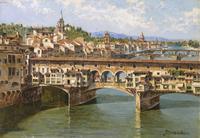
Ponte Vecchio, Florence
Antonietta Brandeis
A step back, Florence
Giuliana Lazzerini
Arno in Florence
Bernardo Bellotto
Firenze
Gerhard Richter
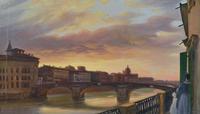
Ponte Santa Trinita
Giuseppe Canella
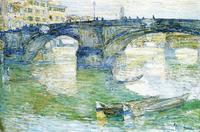
Ponte Santa Trinita
Childe Hassam
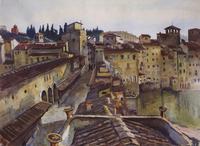
Florence. Ponte Vecchio
Zinaida Serebriakova
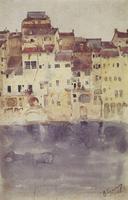
Venice
Vasily Surikov
The Old Bridge
Henri Martin
Rome. The Castel Sant'Angelo
Xavier Mellery
Rome, the Milvian Bridge
Michele Cammarano
Limoux Le pont sur l'Aude
Cricorps
Rome, the Basilica of Constantine
Camille Corot
Bridge. Sevres
Aleksandra Ekster
Island of San Bartolommeo
Camille Corot
The Ponte Sant'Angelo and the Castel Sant'Angelo with St Peter's in the background
Rudolf von Alt
View of Florence from San Miniato
Thomas Cole
Lancaster Church and Bridge
Thomas Girtin