Composition
Analisi esperta di Composition di Mario Sironi
Stile: Futurism · Genere: figurative
Expert Analysis of Mario Sironi’s "Composition" (Futurism, Figurative)
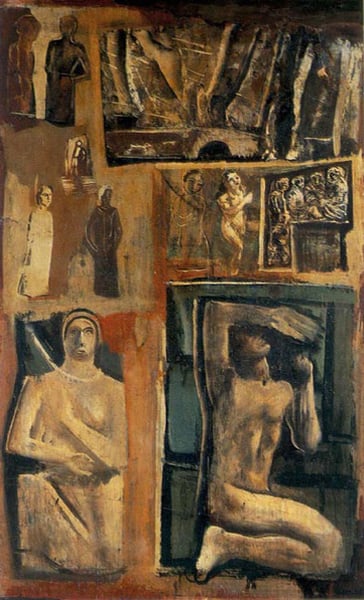
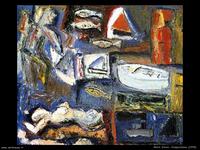
Mario Sironi’s Composition stands as a compelling example of how Futurism—a movement famously obsessed with speed, technology, and the dynamism of modern life—could be rendered through a figurative lens. While many Futurists (e.g., Boccioni, Balla) fragmented bodies into abstract vortices of motion, Sironi grounds his energy in recognizable human or architectural forms, redefining the movement’s expressive range.
Significance within Futurism:
-
Synthetic Dynamism through Figuration
Sironi avoids the purely abstract vortex of lines typical of early Futurism. Instead, he uses geometrized, overlapping planes to suggest a figure in a state of mechanical or urban flux. The composition implies movement not through blurring, but through an almost Cubist compression of time and space—a hallmark of the “second wave” of Futurism that sought order amid chaos. -
Bridging Futurism and Metaphysical Art
By keeping the subject recognizably figurative (perhaps a worker, a machine, or a city dweller), Sironi anticipates his later turn toward Novecento Italiano’s monumental classicism. In Composition, the figure is simultaneously a dynamic force and a solid, almost sculptural mass—foreshadowing the tension between modern energy and traditional structure that defines much of his post-1920 work. -
Industrial Spirit Made Human
The work reflects Futurism’s core creed: the beauty of a factory, a locomotive, a construction site. Here, the figure itself becomes a “human engine,” with angular limbs and faceted torso evoking pistons and gears. This humanization of the machine age makes the painting not just a visual shock, but a ideological statement—that modernity and humanity are inseparable. -
Contribution to Futurist Figurative Vocabulary
Many Futurists abandoned pure figuration after 1915; Sironi maintained it, proving that the movement could convey its revolutionary ideals through identifiable subjects. Composition thus enriches the movement’s legacy, showing that Futurism was not a rejection of the human form, but a radical re-engineering of it for the twentieth century.
In summary, Composition is significant as a synthesis of Futurist dynamism and figurative clarity, offering a unique bridge between the explosive abstraction of early Futurism and the more ordered, monumental aesthetics that followed. It demonstrates that even within a genre as traditional as figuration, Sironi could inject the velocity and disruptive power that define the Futurist spirit.
Visivamente simili
20 opere con composizione e palette affini
Paradise, Adam and Eve
Marcel Duchamp
Figures at Night
Patrick Procktor
Nude with Red Turban
Bela Czobel
Figures by the Sea II
Patrick Procktor
Rajasthani Women
M.F. Husain
Bathing women
Andre Derain
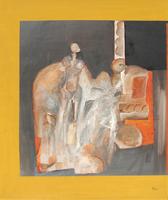
Untitled
Manuel Felguérez
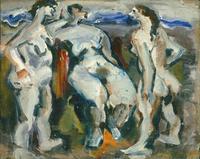
Untitled (Three Nudes)
Mark Rothko
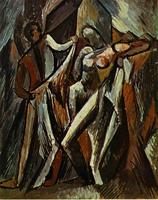
Bathers Drying Themselves
Pablo Picasso
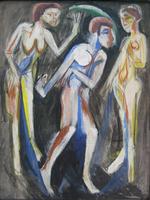
The Dance between the Women
Ernst Ludwig Kirchner
Loneliness for Two
George Stefanescu
Composition
Mario Sironi
Playa
Helen Frankenthaler
Composition (Seated Nude)
Arthur Beecher Carles
Illustration for V. Voiculescu's "Last Shakespearean Sonnets"
Margareta Sterian
Standing Male Nude, Unterengstringen
Max Gubler
Nude in Front of a Mirror
Jean Metzinger
Nude Figures in a Room
Alexandre Jacovleff
Bela Czobel Half Nude
Bela Czobel
Nu Cubista
Anita Malfatti