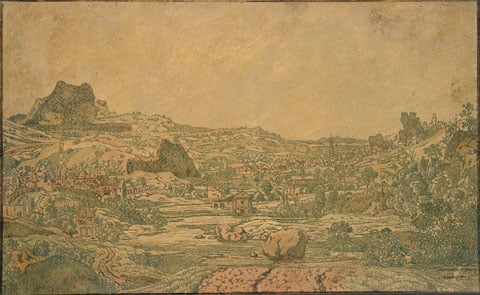
Expert analysis of Hercules Seghers’s Town with four towers
Style: Baroque · Genre: landscape
Expert Art Historical Analysis: "Town with Four Towers" by Hercules Seghers
Hercules Seghers’ Town with Four Towers stands as a singular achievement within the Baroque landscape tradition—a genre typically associated with dramatic chiaroscuro, expansive vistas, and a sense of ordered grandeur. Yet Seghers subverts these conventions, forging a deeply personal, almost visionary approach that marks him as one of the most innovative and idiosyncratic landscape artists of the 17th century.
Significance within the Baroque Style:
While Baroque landscapes often celebrate nature’s sublimity or human dominion (as seen in Claude Lorrain’s idyllic harbors or Jacob van Ruisdael’s majestic forests), Seghers’ work is characterized by a brooding, introspective atmosphere. The “four towers” likely rise from a compact townscape, but their verticality is not triumphant—instead, they seem to strain upward from a rugged, almost barren foreground, set against a vast, turbulent sky. This tension between the man-made and the natural, the minute and the monumental, is quintessentially Baroque in its emotional dynamism, yet Seghers pushes it toward an eerie stillness. His use of subdued, earthy tones and soft, diffused light—often achieved through experimental printmaking techniques—creates a sense of haunting solitude, distinct from the more dramatic lighting expected of Baroque works.
Genre Innovation:
As a landscape, this piece is less a topographical record than a surreal, condensed vision. Seghers was known for reworking and combining motifs from memory and imagination, and Town with Four Towers likely fuses observed details (such as Dutch or Flemish town silhouettes) with a fictionalized topography. The repetition of the four towers—a number laden with symbolic resonance—suggests a deliberate, almost architectural rhythm, anchoring the composition while the surrounding landforms dissolve into soft, atmospheric edges. This balance between precision and ambiguity anticipates the Romantic fascination with the sublime and the uncanny, centuries before its full flowering.
Legacy and Influence:
Seghers’ landscapes were profoundly appreciated—and collected—by Rembrandt, who owned multiple prints by him and even retouched some. Rembrandt’s own etched landscapes, with their intimacy and expressive line, owe a clear debt to Seghers’ pioneering sense of mood and texture. Moreover, Town with Four Towers exemplifies Seghers’ technical daring: he often printed on colored papers or fabric, hand-colored impressions, and used experimental inking to achieve varied effects. Each impression of his prints is essentially unique, blurring the line between original and multiples.
In sum, Town with Four Towers is significant because it expands the Baroque landscape genre beyond its conventional bounds, infusing it with a psychological depth and formal audacity that look forward to Romanticism and even Surrealism. It is a quiet, enigmatic masterpiece that proves the Baroque was not only about spectacle, but also about profound, personal atmosphere.
Visually similar
20 works with related composition and palette
Mountain landscape with a river
Pieter Bruegel the Elder
Landscape Study Development from a Blot
Joseph Wright
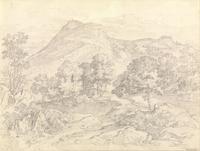
A View of Civitella from the Serpentara next to Olevano
Heinrich Reinhold
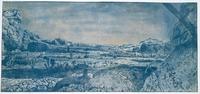
Mountain Valley with Fenced Fields
Hercules Seghers
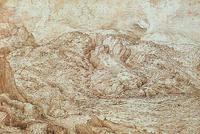
Landscape of the Alps
Pieter Bruegel the Elder
Landscape
Konstantin Bogaevsky
Long rock in the forest of Fontainebleau
Theodore Rousseau
Studie Zum Bild La Natura
Giovanni Segantini
Cimmerian region
Konstantin Bogaevsky
A Village in Summerset
Giorgio de Chirico
Serpentara with a view of Civitella, 23 August 1824
Heinrich Reinhold
View from Stara Planina
Felix Philipp Kanitz
A Winding Estuary
Thomas Girtin
Rocky valley
Theodore Rousseau
Landscape with a shepherd and a dog
Rembrandt
Landscape
Marià Fortuny
Romantic landscape
Konstantin Bogaevsky
Study for Dream of Arcadia
Thomas Cole
Plain
Theodore Rousseau
Out of the forest of Fontainebleau
Theodore Rousseau