Expert analysis of Otto Dix’s Flanders
Style: Verism · Genre: battle painting
Expert Analysis: "Flanders" by Otto Dix
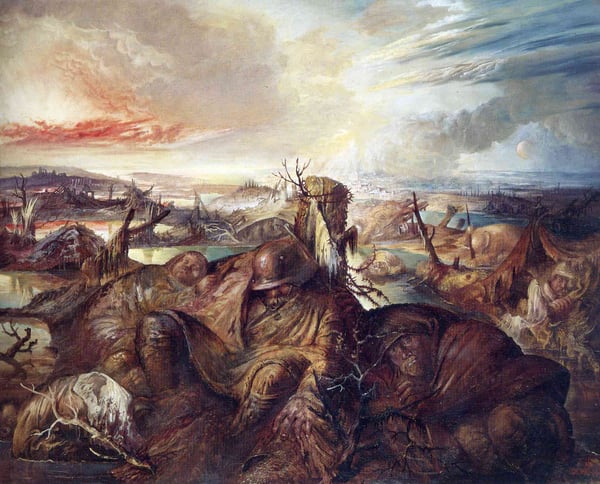
Otto Dix’s "Flanders" stands as a searing indictment of the glorified myth of war, executed in the uncompromising visual language of Verism—the hyper-realist, often grotesque branch of the New Objectivity movement that emerged in Weimar Germany. Painted as a battle genre scene, the work deliberately subverts traditional battle paintings that celebrate heroism. Instead, it forces the viewer into the mud-soaked, corpse-littered reality of World War I trench warfare, specifically in the Flanders region.
Significance within Verism: Dix employs Verism’s hallmark precision—meticulous, almost clinical detail—to amplify the horror. Every fragment of shattered equipment, every distorted body, and the decayed landscape is rendered with the cold objectivity of a forensic report. This techniques strips war of any romanticism. Unlike the expressive distortions of earlier Expressionism, Verism’s detachment makes the atrocity feel all the more immediate and inescapable. The painting functions as a visual autopsy of a generation.
Significance as a Battle Painting: "Flanders" redefines the genre. Traditional battle paintings (e.g., by Delacroix or Meissonier) focus on commanders, flags, and climactic charges. Dix replaces these with a chaotic, sprawling panorama of anonymous, mutilated soldiers in a hellish, cratered landscape. The composition lacks a focal point of victory—instead, it centers on entrapment and decay. The horizon is low, the sky toxic, and the earth devours the men. It is not a battle in progress but a battle’s aftermath—a landscape of death.
Art-Historical and Cultural Weight: Dix personally fought in WWI, and "Flanders" belongs to his series Der Krieg (The War), which he later developed as etchings and paintings. The work is significant as a counter-monument—a visual rebuttal to the nationalist propaganda that sent millions to die. While many artists after the war retreated into abstraction or nostalgia, Dix insisted on depicting the unbearable truth with veristic clarity. "Flanders" thus stands as both a masterpiece of the New Objectivity movement and one of the most powerful anti-war statements in 20th-century art, influencing later generations of artists who use hyperrealism to confront trauma.
Museum / Gallery
Visually similar
20 works with related composition and palette
Moses Striking the Rock
Adriaen van de Venne
Trench Warfare
Otto Dix
The Enigma
Gustave Dore
The Village Funeral
Daniel MacDonald
The Harvest of Battle
C. R. W. Nevinson
Suicidal Attu Island
Tsuguharu Foujita
Battle in the desert
Jean-François Portaels
The appearance
Karl Wilhelm Diefenbach
Idylls of the King
Gustave Dore
Death of Frederick I of Germany
Gustave Dore
Warriors in the Battle of Silistria
Henryk Siemiradzki
The Battle of Mohács (1526)
Bertalan Szekely
Large battle scene between European and Oriental cavalry troops, in wide landscape by the sea
Aniello Falcone
Creation
George Frederick Watts
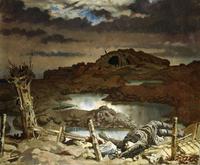
Zonnebeke
William Orpen
Confession
Gustave Dore
Calvary (Crucifixion)
Ilya Repin
Robbery
Francisco Goya
Vagabonds Resting in a Cave
Francisco Goya
Jan Zizka
Jan Matejko