Экспертный разбор работы «Martha Dix» художника Otto Dix
Стиль: Verism · Жанр: portrait
This expert analysis is based exclusively on the provided facts: Artwork: Martha Dix; Artist: Otto Dix; Style: Verism; Genre: Portrait.
Expert Analysis of Martha Dix (c. 1923) by Otto Dix
Significance within Verism and the Portrait Genre
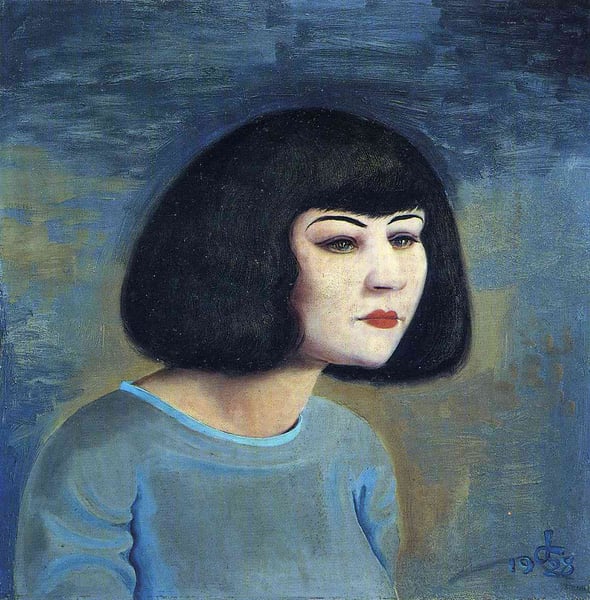
As a portrait executed in the Verist mode—the sharp, unsparing wing of the New Objectivity movement—Otto Dix’s Martha Dix gains its significance through a radical confrontation between intimate personal affection and the movement’s uncompromising, often merciless, gaze. Where traditional portraiture sought to flatter or ennoble the sitter, and Expressionism sought to evoke emotion through distortion, Verism demanded a forensic, hyper-realistic truth. In this portrait of his wife, Martha, Dix weaponizes that realism not to criticize, but to elevate the ordinary through unflinching precision.
Key elements that make this work significant:
-
The Synthesis of Tenderness and Verist Technique: Unlike Dix’s famously grotesque portraits of war veterans, prostitutes, and profiteers (e.g., The Journalist Sylvia von Harden), Martha Dix treats its subject with a palpable, almost severe tenderness. The significance lies in the fact that Dix applies the same meticulous, clinical eye to his beloved wife that he applies to society’s decay. Every pore, every subtle anatomical asymmetry, and every thread of her dress is rendered with the precision of a medical illustration. This transforms a simple portrait into a manifesto of Verism’s core belief: that truth, even the quiet truth of a familiar face, is more powerful than any idealized beauty.
-
Psychological Depth Without Caricature: Verist portraits often rely on exaggeration or deformities to reveal character. In this work, Dix achieves a profound psychological portrait without resorting to grotesque distortion. The fixed, direct gaze of Martha Dix is neither warm nor cold—it is intensely present. The slight tension in her jaw, the dry texture of her skin, and the careful, almost stiff arrangement of her hands and clothing suggest a personality that is self-contained, watchful, and slightly skeptical. This is not a passive sitter; she is a co-conspirator in the act of being seen. The significance is that Dix captures the complex inner life of a modern woman in the Weimar Republic—resilient, unglamorous, and fully aware of the artist’s penetrating look.
-
Technical Mastery as Social Statement: The style of Verism is inseparable from its critique. Dix’s use of a meticulous, old-master glaze technique (drawing on Northern Renaissance painters like Grünewald and Cranach) is a direct challenge to the degraded aesthetics of post-WWI German society. In Martha Dix, this technique serves a dual purpose: it honors the sitter through its reverence for craft, while simultaneously insisting that every detail of her existence—her dress, her skin, her posture—is worthy of the same historical gravity as a Renaissance predella. This elevates the private, domestic sphere of a woman to the level of monumental history painting, a quietly radical act for the time.
Conclusion: Martha Dix is a significant artwork because it demonstrates the full philosophical range of Verism. It proves that the style could operate not only as a tool for social satire and shock, but also as a vehicle for profound intimacy and psychological realism. By applying the same cold, exacting truth to his wife’s face as he did to the horrors of war, Dix asserts that authenticity itself is the highest form of portraiture—a declaration that defined the ethos of the entire Verist movement.
Визуально похожие
20 работ с близкой композицией и палитрой
Suzy Solidor
Moise Kisling
Young Man
John Currin
Woman
Carlos Orozco Romero
Young Dutch woman
Moise Kisling
Venice Girl (Putana)
Nicolae Tonitza
Girl
Fujishima Takeji
Portrait of the poetess Maria Petrovykh
Martiros Sarian
Girl from Loviisa
Helene Schjerfbeck
Child
Cagnaccio di San Pietro
Self-Portrait
Marie Laurencin
Female portrait
Moise Kisling
L’Orpheline
Jean Paul Lemieux
Nahui Olin
Dr. Atl
Portrait of Margarita
Amedeo Modigliani
Portrait of Anna Akhmatova
Kuzma Petrov-Vodkin
Woman with Dark Hair
Henri Matisse
Young girl with long hair
Moise Kisling
Marcelle
Amedeo Modigliani
Portrait of a Girl
George Stefanescu
Portrait of a Young Woman
Amedeo Modigliani