Analisi esperta di Horsemen di Alexander Orlowski
Stile: Romanticism · Genere: genre painting
Expert Art Historical Analysis: "Horsemen" by Alexander Orlowski
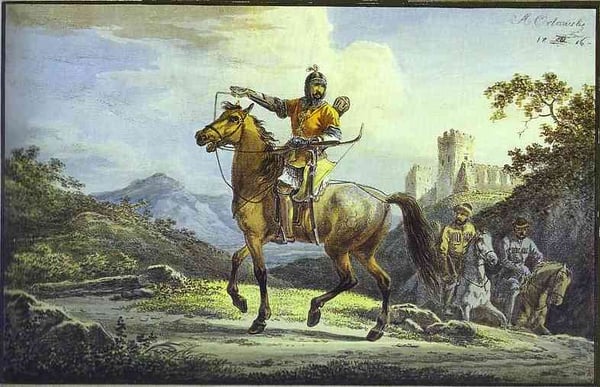
Alexander Orlowski’s "Horsemen" stands as a compelling example of Romanticism’s fascination with dynamic movement, exoticism, and raw human energy. Executed as a genre painting, the work transcends mere documentation of everyday life to embody the Romantic ideal of untamed spirit—here captured in the fleeting, powerful motion of mounted riders.
Significance within Romanticism: The painting is deeply rooted in Romanticism’s celebration of the sublime and the individual. Orlowski, a Polish-born artist who worked extensively in Russia, was drawn to the figure of the horseman—particularly Cossacks—as a symbol of freedom, martial vigor, and the wild, uncharted expanses of the East. In "Horsemen," the composition likely emphasizes dramatic tension: horses mid-gallop, riders leaning forward, wind whipping through manes and cloaks. This kinetic energy aligns with Romanticism’s rejection of neoclassical stasis, instead privileging emotional intensity and the fleeting, often chaotic, moments of life.
Genre Painting Transformed: While genre painting traditionally depicted scenes of common life, Orlowski elevates the mundane to the heroic. The horsemen are not anonymous laborers but archetypes of daring and endurance. Their portrayal reflects Romanticism’s interest in the “other”—nomadic, fierce, and unburdened by civilizing constraints. Orlowski’s brushwork likely conveys a sketch-like spontaneity, prioritizing visceral impact over polished finish, which was a hallmark of his style and a precursor to later 19th-century realism.
Cultural and Artistic Context: Orlowski was a pioneer of lithography in Russia and had a profound influence on Russian Romantic painting. "Horsemen" exemplifies his ability to fuse the theatrical drama of battle-painting with the intimacy of everyday observation. The work captures the Russian imperial fascination with its own frontier—the steppe and its horsemen—as both a threat and a source of national identity. In this, Orlowski’s painting becomes a visual poem: it does not tell a specific story, but evokes the boundless energy of a people in constant motion, a key Romantic trope.
Why It Matters: "Horsemen" is significant for its synthesis of Romantic emotionalism with the genre tradition, offering a glimpse into how 19th-century artists reimagined the quotidian as extraordinary. Orlowski’s horsemen are not just riders; they are embodiments of a Romantic ideal—fierce, free, and eternal—making the painting a touchstone for understanding the period’s visual language of power and passion.
Visivamente simili
20 opere con composizione e palette affini
Auld Wat of Harden
Tom Scott
Hetman Stanisław Jan Jabłonowski, Obraz
Piotr Michałowski
Portrait of Denis Davydov
Alexander Orlowski
Caucasian battle
January Suchodolski
Don Quixote and Sancho Setting Out
Gustave Dore
Don Quixote
Gustave Dore
The death of Laras
Eugene Delacroix
Mounted Artilleryman Leading Three Horses
Carle Vernet
Cossack Cavalier
Carle Vernet
A Heroine Florine of Burgundy
Gustave Dore
Scene
Alexander von Bensa
The Discovery of the Mississippi
Currier and Ives
Volga Vseslavevich
Andrei Ryabushkin
Arabs Skirmishing in the Mountains
Eugene Delacroix
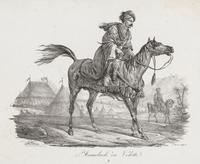
Mounted Mamelucke
Carle Vernet
Chodkiewicz after the Battle of Kirchholm
January Suchodolski
The Polish Rider
Rembrandt
Homage to Jadwiga
January Suchodolski
Sir John Leicester, Bt, Exercising His Regiment of Cheshire Yeomanry on the Sands at Liverpool
James Ward
Caucasian Landscape
January Suchodolski