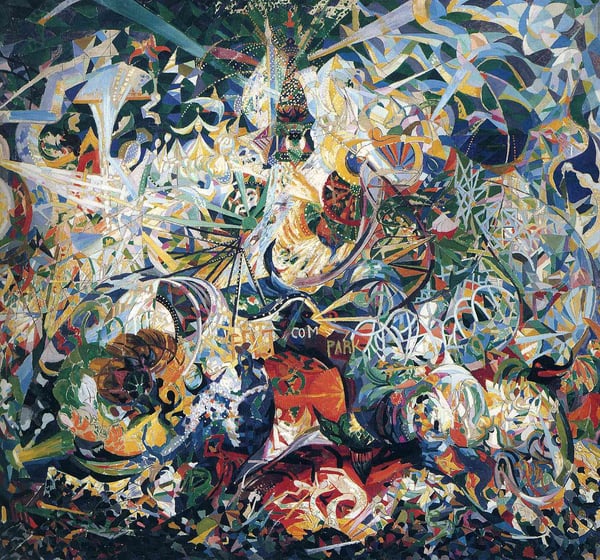
Battle of Lights, Coney Island
Joseph Stella sanatçısının Battle of Lights, Coney Island eseri hakkında uzman analizi
Tarz: Futurism · Tür: abstract
Expert Analysis: "Battle of Lights, Coney Island" by Joseph Stella
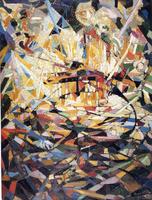
Joseph Stella’s "Battle of Lights, Coney Island" is a seminal work of Futurism and a landmark in early American abstraction. Created between 1913–1914, the painting captures the dazzling, chaotic energy of Coney Island’s amusement park at night—a subject that perfectly embodies the Futurist obsession with speed, dynamism, and the modern urban spectacle.
Significance within Futurism
Stella, an Italian-born artist who migrated to the United States, brought the radical principles of Italian Futurism to an American context. Futurism celebrated technology, movement, and the fragmentation of experience. In this abstract composition, Stella translates the sensory overload of Coney Island’s electric lights, roller coasters, and carnival crowds into a whirlwind of intersecting arcs, zigzagging lines, and pulsating color fields. The “battle” of the title refers not to warfare but to the clash of artificial lights—a veritable symphony of neon, incandescence, and shadow. The painting rejects traditional perspective in favor of a centrifugal, almost explosive visual field, forcing the viewer to feel the dizzying rush of modern life.
Pioneering American Abstraction
Though Futurism was born in Europe, "Battle of Lights, Coney Island" stands as one of the first fully realized abstract works by an American artist. Stella’s approach is not merely decorative; it is a structured, analytical deconstruction of visual stimuli. He breaks down the park’s forms into vibrating planes of primary colors—reds, yellows, blues—and dynamic diagonals. The composition radiates outward from a central vortex, mimicking the centrifugal motion of a carousel or the glare of searchlights. This abstract language directly channels the Futurist manifestos of Marinetti and Boccioni, yet it is unmistakably New York in its subject matter: a democratic, popular amusement park rather than a machine or a speeding automobile.
Legacy
The artwork is significant because it bridges European avant-garde theory with American subject matter, while also pushing the boundaries of abstraction. It predates and influences later developments in American modernism, such as Synchronism and Precisionism. Stella’s vibrant, synesthetic treatment of light and motion prefigures the work of the Abstract Expressionists, who would similarly seek to translate raw energy onto canvas. In "Battle of Lights, Coney Island," the chaos of the fairground becomes a metaphor for the modern condition—fragmented, electrified, and relentlessly alive.
Görsel olarak benzer
İlişkili kompozisyon ve renk paletine sahip 20 eser
Fugue
Wassily Kandinsky
Hommage à Stravinsky
Endre Rozsda
Formula of Spring
Pavel Filonov
Composition VII
Wassily Kandinsky
Sacred and Profane Love
Endre Rozsda
My Grandmother's Lorgnette
Endre Rozsda
Formula of the Cosmos
Pavel Filonov
Visage pâle
Endre Rozsda
Revenant perpétuel
Endre Rozsda
Initiation
Endre Rozsda
Fumée et arbres en fleurs
Jacques Villon
Tornado Tango
Martin Disler
Le Château de Barbe-Bleue
Endre Rozsda
In Grey
Wassily Kandinsky
Angel of the Last Judgment
Wassily Kandinsky
Portrait of My Mother
Boris Margo
The Tower of Babel
Endre Rozsda
Battle of Lights, Coney Island
Joseph Stella
Flying
Endre Rozsda
The Temptation of St. Anthony
Ivan Albright