
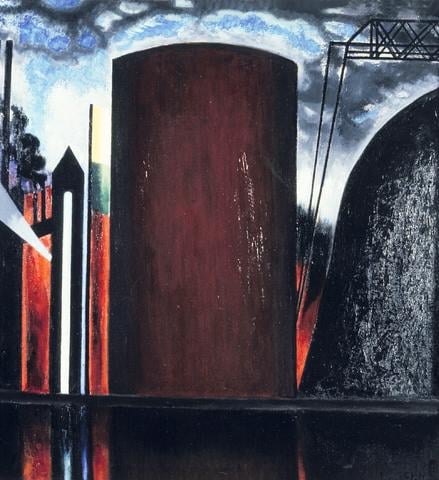
Smoke Stack
Expert analysis of Joseph Stella’s Smoke Stack
Style: Futurism · Genre: cityscape
Expert Analysis: "Smoke Stack" by Joseph Stella
Joseph Stella’s Smoke Stack is a seminal work of American Futurism, a style that fused the Italian movement’s obsession with speed, technology, and dynamic energy with the raw, industrial landscape of the United States. Painted during the early 20th century, this cityscape elevates a single industrial chimney—usually a banal element of urban infrastructure—into a soaring monument of modern power and aspiration.
Significance within Futurism:
- Dynamic composition: Stella employs diagonal lines, fractured planes, and a sense of upward thrust that mirrors the smokestack’s vertical ascent, converting static engineering into pulsing, kinetic energy. The smoke plumes twist and spiral, embodying the Futurist principle that “a roaring car is more beautiful than the Victory of Samothrace.”
- Technological sublime: The smokestack is not depicted realistically but as a glowing, almost sacred engine of progress—a cathedral of industry. Stella’s bold, stark contrasts of black, white, and metallic tones focus attention on the machine as a source of awe rather than pollution.
Significance within Stella’s oeuvre:
- Smoke Stack belongs to Stella’s iconic series of works inspired by the factories and bridges of Pittsburgh and New York, notably his large-scale Brooklyn Bridge paintings. Here, he distills the Futurist manifesto into a single, penetrating vertical shaft, achieving a concentrated impact that his more sprawling compositions sometimes lack.
- The piece bridges European avant-garde theory and American subject matter, proving that Futurism could transcend its Italian origins to capture the unique spectacle of American industry.
Art historical impact:
- This painting anticipates later Precisionist and modernist approaches to industrial landscapes, where the smokestack becomes a symbol of national identity. Stella’s ability to fuse abstraction with recognizable urban forms helped legitimize the industrial cityscape as a subject worthy of high modernist art.
In short, Smoke Stack is significant for its radical reimagining of an industrial object as an emblem of Futurist dynamism, for its masterful compression of motion into a single frame, and for its lasting influence on how American artists portrayed the built environment.
Visually similar
20 works with related composition and palette
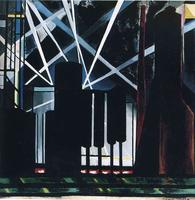
By-Products Plants
Joseph Stella

La raffinerie de pétrole
Gustave Buchet
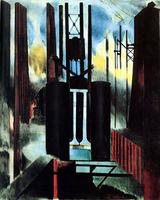
Factories
Joseph Stella
Factories
Joseph Stella
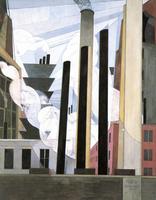
End of the Parade, Coatesville, Pa.
Charles Demuth
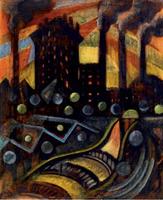
Scheiber Hugó, Esti Fények
Scheiber Hugó

Depósito de óleo
Candido Portinari
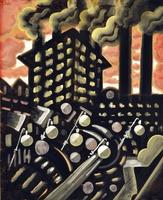
Scheiber Hugó, Külváros
Scheiber Hugó

The Lights of the Plant
Maria Stolarova

Scherzo (Sonata of the Serpent)
Mikalojus Konstantinas Ciurlionis

Scheiber Hugó, Nagyvárosi Fények
Scheiber Hugó
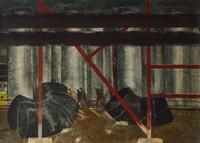
Heating Pipes, Kamaz
Petros Malayan

Incense of a New Church
Charles Demuth
Plant
Maria Stolarova

Industrial Landscape
Maria Stolarova
Scheiber Hugó Nagyváros
Scheiber Hugó

Factory
Spyros Vassiliou

Houses in Flames
Jean David
Transport forces
Fernand Leger

Scheiber Hugó, Gyárváros
Scheiber Hugó