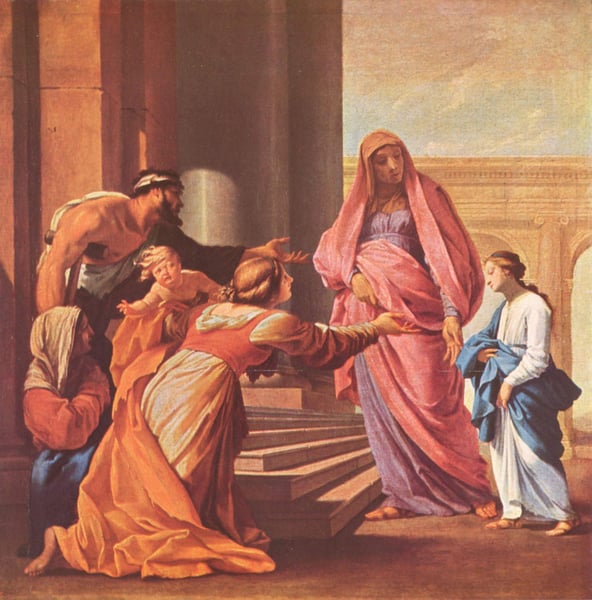
Presentation of the Virgin in the Temple
Details
Expert analysis of Eustache Le Sueur’s Presentation of the Virgin in the Temple
Style: Baroque · Genre: religious painting
Eustache Le Sueur’s Presentation of the Virgin in the Temple stands as a defining example of the French Baroque’s synthesis of classical order and spiritual intensity. Painted in the mid-17th century, the work reflects Le Sueur’s reputation as the “French Raphael” – a painter who blended the serene, balanced compositions of High Renaissance humanism with the emotive clarity demanded by Counter-Reformation piety.
What makes this piece significant is its masterful orchestration of sacred narrative and formal harmony. Le Sueur depicts the young Virgin Mary ascending the steps of the Temple, a moment that bridges earthly obedience and divine election. The composition is rigorously structured: the architectural setting provides a measured, almost stage-like frame, while the central axis draws the eye upward, echoing Mary’s spiritual ascent. Unlike the dramatic, chiaroscuro-driven intensity of Italian Baroque (such as Caravaggio), Le Sueur opts for a refined, luminous palette and a controlled emotional tenor. The figures are graceful, their gestures restrained, and the light diffuses evenly, creating a sense of quiet reverence rather than theatrical awe.
This approach is quintessentially French Baroque, rooted in the classical ideals promoted by the Académie Royale de Peinture et de Sculpture, of which Le Sueur was a founding member. His work here exemplifies the academic preference for disegno (drawing and design) over pure colore (coloristic drama), aligning with Nicolas Poussin’s intellectual clarity. Yet Le Sueur adds a distinctly tender, contemplative spirituality – the young Virgin’s upward gaze and the gentle leading of her parents, Joachim and Anne, imbue the scene with both human intimacy and liturgical solemnity.
As a religious painting from the Baroque period, it fulfills the Church’s desire for accessible yet elevated visual instruction. But Le Sueur’s Presentation is noteworthy because it achieves this without sacrificing aesthetic refinement: the carefully balanced masses, the muted yet warm tonality, and the palpable sense of sacred space make it a masterpiece of poised devotion. It stands as a key work in the transition from the mannerist excesses of the late 16th century to the more disciplined, rhetorically controlled Baroque that would define French painting for generations.
Museum / Gallery
Visually similar
20 works with related composition and palette
Virgil Reading the Aeneid to Augustus and Octavia
Angelica Kauffman
Psyche Honoured by the People
Luca Giordano
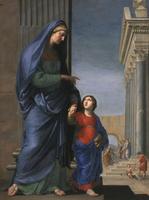
Sainte Anne leading the Virgin in the Temple
Jacques Stella
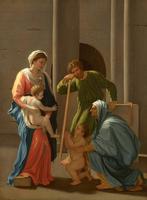
The Holy Family with Saints Elizabeth and John
Nicolas Poussin
Presentation of Christ in the Temple
Simon Vouet
The Marriage of the Virgin
Jacques Stella
Saints Peter and John Healing the Lame Man
Nicolas Poussin
The Marriage of the Virgin
Nicolas Poussin
The Death of Sapphira
Nicolas Poussin
Oedipus Bids Farewell to Jocasta (study)
Alexandre Cabanel
Sinite Parvulos
Otto van Veen
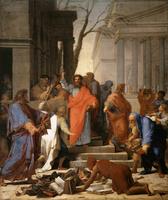
The Preaching of St. Paul at Ephesus
Eustache Le Sueur
Ester davanti ad Assuero
Pompeo Batoni
The Vestals Attending the Sacred Fire
David Allan
Cornelia Africana
Angelica Kauffman
Judgment of Solomon
Konstantin Flavitsky
Christ at the Pool of Bethesda
Bartolome Esteban Murillo
Esther before Ahasuerus
Nicolas Poussin
The Rest on the Flight into Egypt
Nicolas Poussin
Holy Family on the Steps
Nicolas Poussin