Analisi esperta di Standing Arab Woman di Edwin Lord Weeks
Stile: Orientalism · Genere: portrait
Expert Analysis of "Standing Arab Woman" by Edwin Lord Weeks
Style: Orientalism | Genre: Portrait
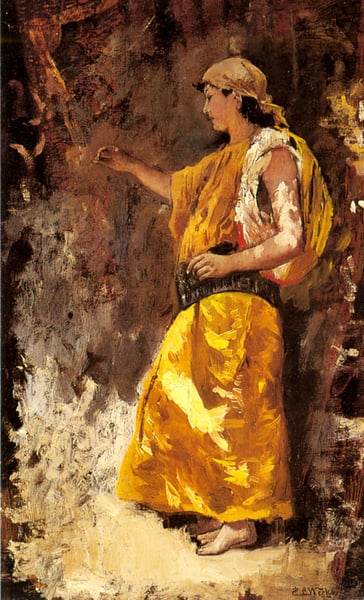
Edwin Lord Weeks (1849–1903) was a leading American Orientalist painter whose work is celebrated for its ethnographic precision, luminous color, and architectural detail. In this portrait, Standing Arab Woman, Weeks exemplifies the core preoccupations of the Orientalist movement: the romanticized yet meticulously observed depiction of Middle Eastern and North African subjects.
Significance within Orientalism
Orientalist portraiture often served both as a document of cultural curiosity and as a vehicle for Western fantasies of the "exotic." Weeks distinguishes himself by balancing the genre’s inherent theatricality with a degree of naturalism and respect for his sitter’s individuality. Unlike many Orientalist painters who focused on market scenes or harem fantasies, Weeks’s portrait of a standing Arab woman emphasizes dignity, composure, and a quiet presence. Her stance, direct gaze, and detailed costume (likely a thobe or kaftan with regional embroidery) suggest a specific, localized identity rather than a generic type.
Artistic and Technical Distinction
Weeks was a master of light and texture, qualities evident in the painting’s handling of fabric, skin tone, and shadow. The woman’s garments are rendered with almost tactile richness—the folds of her dress, the gleam of metallic thread or jewelry, and the subtle play of light across her face and hands. This attention to material detail reflects Weeks’s training under Jean-Léon Gérôme, another giant of Orientalism, and his own extensive travels through Egypt, Syria, and India.
The composition is spare yet potent: a single figure set against a muted background (possibly an architectural element or neutral wall), which focuses all attention on the subject’s bearing and attire. This isolation of the figure—common in Weeks’s portraits—elevates the work from a mere costume study to a nuanced character portrait.
Why It Matters
Standing Arab Woman is significant because it complicates the Orientalist tendency to flatten diverse cultures into a single, picturesque ideal. Weeks’s commitment to accurate observation—seen in the specific cut of the clothing, the style of headcovering, and the woman’s confident posture—offers a glimpse of authentic 19th-century life filtered through a Western lens. It stands as a testament to Weeks’s skill in marrying the pictorial beauty of Orientalism with a humanizing specificity, making it a valuable example of how the movement could produce works of genuine cross-cultural—if still colonial—encounter.
In summary, this portrait is not merely a decorative Orientalist piece; it is a carefully wrought character study that reflects Weeks’s unique blend of artistic virtuosity and ethnographic curiosity, securing its place as a notable work within the genre.
Museum / Gallery
Visivamente simili
20 opere con composizione e palette affini
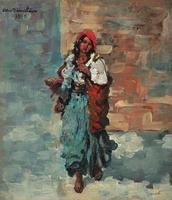
Gypsy Woman with Red Headscarf
Octav Bancila
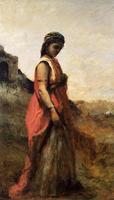
Judith
Camille Corot
Dunkey Driver in Cairo
Vasily Polenov
Girl with Falcon
Pierre-Auguste Renoir
Gipsy
Konstantin Makovsky
The Flower Girl
Nicolae Vermont
Peasant Woman with Jar
Rudolf Schweitzer-Cumpana
A moroccan
Marià Fortuny
The Rider
Edwin Lord Weeks
The Guitarist
Maurice Bompard
Young women above river landscape
Henryk Siemiradzki
Dervish
Konstantin Makovsky
Woman by the Sea
Pierre Puvis de Chavannes
Moor
Joaquín Agrasot
An Arab Examining a Pistol
Joaquín Sorolla
Sketch Two Nautch Girls
Edwin Lord Weeks
Portrait of a young girl
Romualdo Locatelli
The Gilded fan
Albert Joseph Moore
The blue kimono
Giacomo Favretto
Faun and Nymphs in a Landscape
Ker-Xavier Roussel