Martha Dana
Anders Zorn sanatçısının Martha Dana eseri hakkında uzman analizi
Tarz: Realism · Tür: portrait
Expert Analysis of Martha Dana by Anders Zorn
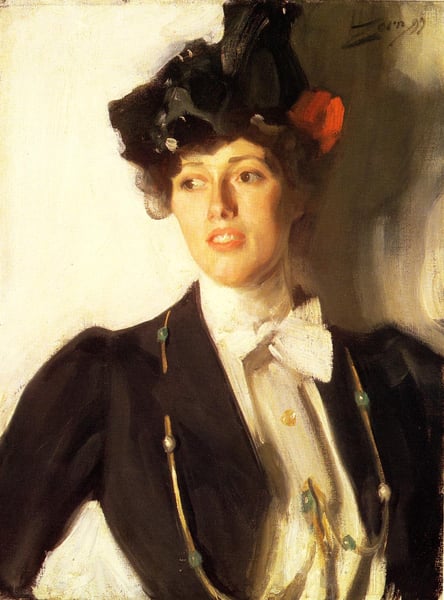
Anders Zorn’s Martha Dana exemplifies the pinnacle of late‑19th‑century Realist portraiture, a genre in which the Swedish master achieved international acclaim. Painted during a period when Zorn frequently traveled to the United States to portray members of the Gilded Age elite, this work demonstrates his signature ability to merge acute visual fidelity with a palpable sense of the sitter’s inner life.
Stylistic Significance within Realism Zorn’s approach to Realism was never merely photographic. Instead, he distilled the essence of his subject through bold, fluid brushwork that captures the interplay of natural light with skin, fabric, and surrounding space. In Martha Dana, one can observe his characteristic “Zorn palette” — a restricted yet rich harmony of ochres, umbers, ivory black, and vermilion — which allows him to model form with remarkable economy while preserving a luminous vitality. The loose, almost impressionistic handling of the background and clothing contrasts with the precise rendering of the face, drawing the viewer’s focus directly to the sitter’s expression and presence.
Significance of the Portrait Martha Dana, likely an American socialite or member of a prominent family, is presented with a quiet dignity that transcends mere social record. Zorn’s Realism here is not about documenting wealth or status but about capturing a specific human truth: the momentary yet timeless attitude of a woman composed for her portrait. The slight turn of the head, the direct yet soft gaze, and the naturalistic treatment of her hands all contribute to a psychological depth that was Zorn’s hallmark. He avoids idealization; instead, he celebrates the individual character of his sitter through meticulous observation of light falling across her features and the texture of her attire.
Technical Mastery Zorn’s brush technique in Martha Dana is particularly noteworthy. He often left passages of the canvas exposed, allowing the ground to gleam through and enliven the surface. The swift, confident strokes that define the fabric and background create a sense of immediacy, while the face is built with layered, delicate touches that model bone structure and soft tissue without losing spontaneity. This balance between finish and sketch, between exactness and expressiveness, is what sets Zorn apart within the Realist tradition.
Historical and Artistic Context Completed during the peak of Zorn’s American period (c. 1890s–1900s), this portrait reflects the cross‑cultural exchange between European painting traditions and the New World’s appetite for refined, naturalistic likenesses. Martha Dana is significant not only as a stunning example of Zorn’s technical prowess but also as a document of the era’s social milieu. The work stands as a testament to how Realism, in Zorn’s hands, could transcend documentary function and ascend to the level of profound humanistic art.
Görsel olarak benzer
İlişkili kompozisyon ve renk paletine sahip 20 eser
Madame Claude Monet
Pierre-Auguste Renoir
Portrait of a young, pretty woman with a large flower-trimmed hat and red-brown jacket
Isaac Israels
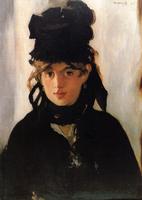
Berthe Morisot with a bouquet of violets
Edouard Manet
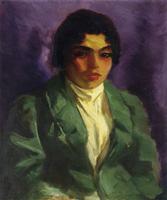
The Green Coat
Robert Henri
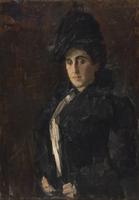
Portrait of a Woman
Isaac Israels
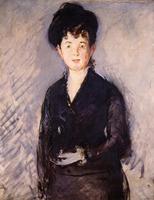
Woman with a gold pin
Edouard Manet
Woman in White
William Merritt Chase

Alice Vanderbilt Shepard
John Singer Sargent
Portrait of Alma
Carl Larsson

Violet
John Singer Sargent
Elsie Wright
Ralph Hedley
The Beach Hat
Robert Henri
Young woman in the living room
Pompeo Mariani
Study of Black against Yello
William Merritt Chase
Portrait of Lola Braz
Zinaida Serebriakova
First Portrait of Madame Georges Charpeitier
Pierre-Auguste Renoir
Miss Frances Sherborne Ridley Watts
John Singer Sargent
V.A. Repina
Ilya Repin

Esther Kenworthy
John William Waterhouse
Lady in a Black Dress
Pierre-Auguste Renoir