
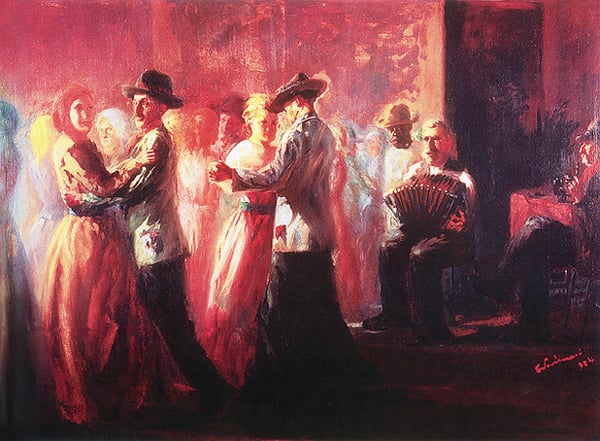
Analisi esperta di Baile na Roça di Candido Portinari
Stile: Post-Impressionism · Genere: genre painting
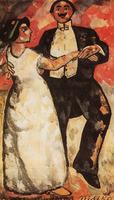
"Baile na Roça" (Country Dance) by Candido Portinari is a vibrant exemplar of Brazilian Post-Impressionism that elevates a humble rural festivity into a powerful statement of national identity. Painted in the early 20th century, this genre scene captures a lively gathering in the Brazilian countryside, where peasants dance to the sound of traditional music under a dramatic sky.
Significance within Post-Impressionism and Genre Painting: Portinari’s work stands at the intersection of European modernism and Brazilian cultural roots. While Post-Impressionism—as practiced by Gauguin, Van Gogh, and Seurat—emphasized emotional expression, symbolic content, and bold, non-naturalistic color, Portinari adapts these principles to tell a distinctly Brazilian story. In Baile na Roça, the figures are simplified, almost sculptural, with elongated limbs and stylized poses that recall Gauguin’s primitivism yet are infused with the rhythmic energy of a batuque or samba. The palette is deliberately heightened: deep ochres, vibrant blues, and earthy reds create a sense of heat and joy, while the flattened perspective and strong outlines give the composition a graphic, mural-like quality.
What Makes It Significant:
-
Celebration of Brazilian Folk Culture: The painting is a courageous departure from academic European traditions that dominated Brazilian art. Portinari foregrounds a gente brasileira—the mixed-race, working-class communities of the interior—treating their customs and celebrations with dignity and monumentality. The dancers’ bare feet, the simple rural architecture, and the musical instruments (likely a viola and accordion) are not exoticized but presented as the heart of national identity.
-
Social and Political Resonance: Painted during a period of modernization and industrialization in Brazil, Baile na Roça serves as a nostalgic yet urgent record of disappearing rural traditions. Portinari, a committed leftist, subtly critiques social inequalities by depicting the resilience and joy of marginalized peoples. The painting’s warmth and dynamism resist condescension; instead, it asserts that the “Roça” (countryside) is a source of authentic Brazilian culture.
-
Muralistic Ambition in Small Scale: Although an easel painting, the composition prefigures Portinari’s later monumental murals (like those at the Ministry of Education in Rio). The figures seem larger than life, their bodies filling the canvas, and the sky—a swirling mass of blue and white—suggests a cosmic backdrop. This tension between intimate genre scene and epic scope makes the work remarkable.
In summary, Baile na Roça is significant because it marries the formal innovations of Post-Impressionism—bold color, expressive line, simplified form—with the deeply human project of documenting and honoring Brazil’s rural soul. It is at once a lively dance and a quiet manifesto for cultural pride.
Genere
Stile
Visivamente simili
20 opere con composizione e palette affini
The Waltz
Anders Zorn
In a Ballroom
Mahmoud Saiid
Stomp
Archibald Motley
Dancing at the Moulin Galette
Isaac Israels
SAINT-GERMAIN NIGHTCLUB
Gerard Sekoto
Amor Brujo
José Garnelo
Waltz
Anders Zorn
Deja
Biruta Baumane
Bal de Barriere drawing
Theophile Steinlen
El Jaleo
John Singer Sargent
Study for The Spanish Dance
John Singer Sargent
Night Life
Robert Spencer
Candombe
Pedro Figari
Ballerina in Mauve
Giovanni Boldini
Ball in Paris suburb
Theophile Steinlen
Der Wirbelwind (Tourbillon)
Louis Adolphe Tessier
A Hunt Ball
Julius LeBlanc Stewart
Matrosbal
Eugène Jansson
Couple Dancing
Vincent van Gogh
Argentine Polka
Kazimir Malevich