Description
Style : Baroque · Genre : portrait, vanitas
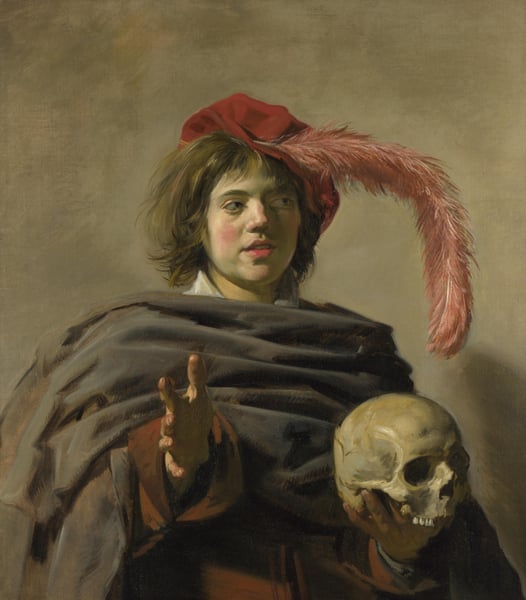
Young man with a Skull (1626-1628), by Frans Hals, is an intriguing case in which art historians and experts split in their interpretation and understanding of the painting and its iconography. According to one, the painting is linked to the tradition of Vanitas. Vanitas is a subject in art, which developed in Netherlandish art during the 15th century, and later became an independent genre. The name Vanitas originates in the biblical quote from the Book of Ecclesiastes: “Vanity of vanities, saith the preacher, all is vanity.” The subject of Vanitas reminds of the temporality of life and the inevitability of death. Symbols of Vanitas allude to the passage of time and the brevity of life, like the skull, rotting fruit, the hourglass, and the pocket watch. In still life paintings, these are usually combined with symbols of earthly pleasures, such as goblets, jewelry, musical instruments, etc.
Therefore, we can interpret Young man with a Skull not only as a work of portraiture but also as an image that symbolizes the transience of life. The contrast between life and death is heightened through the color scheme. The young man’s bright face, flushed cheeks, and red cap highlight his youth and vitality, while the skull is in a darker setting against the shaded drapery. Furthermore, there is precedent to the iconography of a man holding a skull that dates back to the early 16th century, such as the engraving of Lucas van Leyden, Young Man with a Skull (ca. 1519). Other Dutch painters also used this scheme to depict the subject of Vanitas, such as Jan Miense Molenaer, who was possibly a pupil of Frans Hals, in Self Portrait (1640) and Leiden born painter Jan Lievens in Old Man Holding a Skull (ca.1630).
The second interpretation argues that Hals’s painting depicts an actor playing the role of Hamlet. Hamlet is commonly depicted holding a skull, referring to the moment where he speaks the famous phrase, ‘to be or not to be.’ There is an obscured but significant difference between Hals’s paintings and the abovementioned depictions of Vanitas by Molenaer and Lievens. While the figures in the Molenaer’s and Lievens’s paintings make direct eye contact with the viewer, the young man in Hals’s artwork is looking sideways, out of the scene. The young man’s gaze is enigmatic and questioning, creating a moment of drama and tension in the painting. The complex facial expression certainly falls in line with the drama of the theatrical world. Specifically, with the dramatic content of Hamlet’s speech, that deals with the existential question of life and death. The relatively secure and even-tempered posture of the young man is characteristic of a figure seriously contemplating death in the times of Hals and Shakespeare. There is no way to confirm Hals’s familiarity with Shakespeare or whether Hals had an opportunity to see a performance of Hamlet at the time he painted Young man with a Skull. For this reason, the possibility of Hals depicting Hamlet is unlikely. Nevertheless, there is no conclusive evidence to point to the intention of the artist, so both interpretations remain plausible.
Museum / Gallery
Visuellement similaire
20 œuvres à la composition et à la palette proches
Sir William Petty
Isaac Fuller
Self-portrait
Jan Miense Molenaer
Portrait of a Man, Holding a Wite Plume
Ferdinand Bol
Singing Boy with a Flute
Frans Hals
A Standing Man
Pieter Jansz. Quast
Portrait of John Viscount Garlies, Later 7th Earl of Galloway, as Master of Garlies
Anton Raphael Mengs
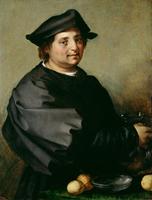
Domenico di Jacopo di Matteo, called 'Becuccio Bicchieraio'
Andrea del Sarto
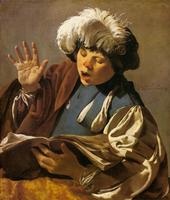
Singing Boy
Hendrick Terbrugghen
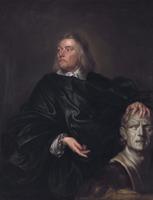
Edward Pierce
Isaac Fuller
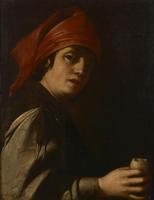
Jeune garçon tenant un oeuf ouvert
Pietro Paolini
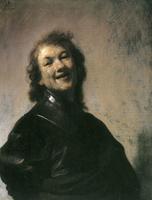
The Young Rembrandt as Democritus the Laughing Philosopher
Rembrandt
Terzi
Nicola Samorì
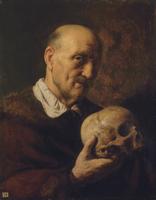
Old Man Holding a Skull
Jan Lievens
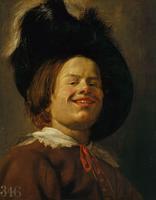
Portrait of a Laughing Boy
Jan Miense Molenaer
Young Man with a Fiddle
Matthias Stom
St. Mary of Egypt
Jusepe de Ribera
A young boy in a red feathered hat
Leonello Spada
Portrait of a Youth
Anne-Louis Girodet
The Fortune Teller
Caravaggio

A guitar-player
Pietro Paolini