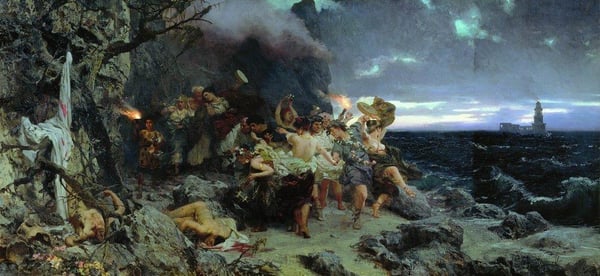
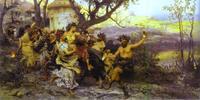
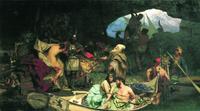
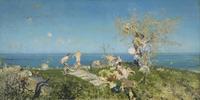
The painting "Orgy of the Times of Tiberius on Capri" by Henryk Siemiradzki is a significant example of Academicism applied to genre painting. Its importance lies in how it synthesizes the academic ideals of technical mastery, classical order, and historical narrative with the genre painter’s focus on everyday (albeit ancient) life—in this case, the morally charged leisure of the Roman elite.
As an academic work, Siemiradzki demonstrates rigorous draftsmanship, balanced composition, and a polished finish that elevates a potentially sensationalist subject to a dignified, almost archaeological tableau. The subject matter—the infamous debauchery of Emperor Tiberius on Capri—allows the artist to display his command of anatomy, of luxurious fabrics and marble, and of theatrical lighting, all hallmarks of the academic style.
What makes this piece particularly significant within Academicism is its moral ambiguity: rather than a straightforward condemnation of decadence, Siemiradzki’s precise, beautiful rendering flirts with aesthetic allure, forcing the viewer to confront the tension between technical perfection and the corruption it depicts. This is typical of late-19th-century academic genre painting, which often used historical or mythological scenes to comment on contemporary societal excess. By choosing a historical (Tiberian) moment, Siemiradzki legitimizes the genre scene as a vehicle for both entertainment and moral reflection—a key contribution of Academicism to the broader understanding of history painting.