Expertenanalyse zu Jean-Leon Geromes Cave Canem
Stil: Orientalism · Genre: genre painting
Expert Analysis: Cave Canem by Jean-Léon Gérôme
Style & Context:
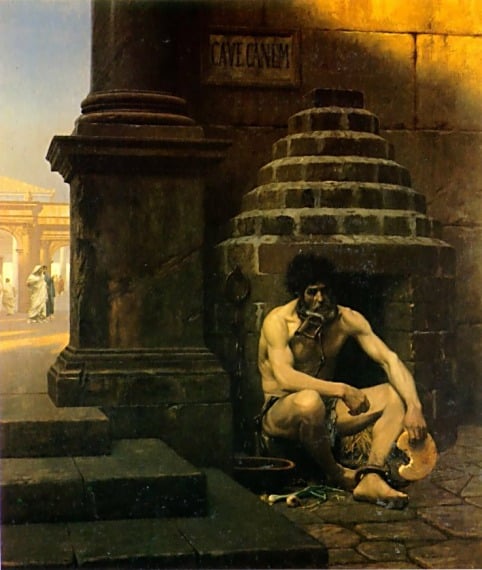
Cave Canem (Latin for “Beware of the Dog”) exemplifies the Orientalist movement, a 19th-century trend in which Western artists depicted imagined or observed scenes from the Middle East, North Africa, and antiquity. Gérôme, a leading Academic painter, blended meticulous realism with theatrical narrative, often transporting viewers to exotic or ancient settings. Though the title references a Roman motif (the famous Pompeian mosaic of a chained dog), the work’s attention to architectural detail, costume, and atmospheric light reflects Orientalism’s fascination with foreign cultures—here, a romanticized vision of ancient Rome as an “exotic” past.
Genre Painting Significance:
As a genre painting, Cave Canem captures a slice of everyday life—a domestic courtyard with a guard dog, a servant, and a visitor—but infuses it with dramatic tension. Gérôme elevates the mundane by focusing on the dog’s bristling stance and the guarded figure beyond, turning a simple “beware” into a study of power, loyalty, and threshold. The composition’s rigorous geometry (the doorway, the tiled floor, the mosaic’s inscription) and the dog’s lifelike musculature showcase Gérôme’s academic precision, while the warm, dusty light and textured stone create an almost archaeological authenticity.
Why It Matters:
- Mastery of Narrative: Gérôme compresses an entire story into a single moment—the visitor’s halted step, the dog’s warning growl, the servant’s presence—inviting viewers to imagine what happens next.
- Orientalist Tropes Reimagined: Instead of a harem or bazaar, Gérôme applies Orientalist exoticism to classical antiquity, treating ancient Rome as an equally “other” realm. This broadened the genre’s scope and influenced later historical painters.
- Technical Virtuosity: The painting’s textures—fur, marble, brass, fabric—are rendered with photo-like detail, a hallmark of Gérôme’s method and a testament to his belief that art should be as “truthful” as a photograph (yet carefully staged).
Legacy:
Cave Canem remains a textbook example of how Orientalism used rigorous realism to romanticize the past. It demonstrates Gérôme’s ability to make a silent moment feel charged with narrative, embodying the 19th-century fascination with worlds both distant and lost.
Visuell ähnlich
20 Werke mit ähnlicher Komposition und Farbpalette
Diogenes
Jean-Leon Gerome
The Captive, from Sterne
Joseph Wright
São João Batista no cárcere
Victor Meirelles
The Slave Market
Gustave Boulanger
The Prisoner of Chillon
Eugene Delacroix
Apollo and Marsyas
Giovanni Battista Tiepolo
Hercules Diverts the River Alpheus
Francisco de Zurbaran
Samson and the Philistines (Samson in the Threadmill)
Carl Bloch
The Yard of a Madhouse
Francisco Goya
A rich man and Lazarus
Vasily Surikov
The zurfegna water in Santa Lucia
Vincenzo Caprile
Plot
Wojciech Siudmak
Cassandra Begging Minerva for Vengeance on Ajax
Jérôme-Martin Langlois
The Irish Whiskey Still
David Wilkie
The Slave
John William Waterhouse
Lamentations over the Death of the First-born of Egypt
Charles Sprague Pearce
Two Shepherds
Christoffer Wilhelm Eckersberg
Anacreon
Jean-Leon Gerome
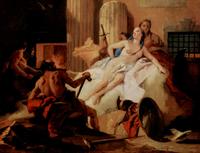
Venus and Vulcan
Giovanni Battista Tiepolo
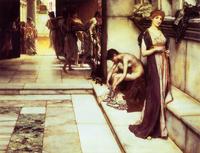
The Apodyterium
Sir Lawrence Alma-Tadema