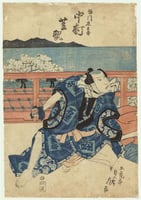
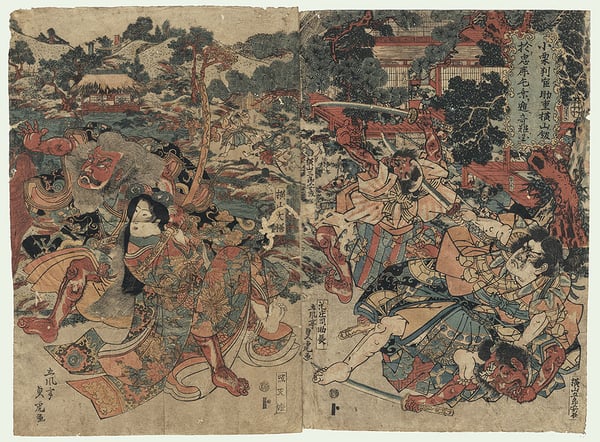
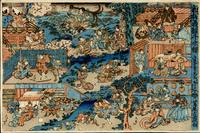
Oguri Hangan Sukeshige in Battle
Expert analysis of Utagawa Sadatora’s Oguri Hangan Sukeshige in Battle
Style: Ukiyo-e · Genre: battle painting
This expert analysis focuses on the historical and stylistic significance of "Oguri Hangan Sukeshige in Battle" by Utagawa Sadatora, based on the provided facts.
Significance Within Ukiyo-e and the Battle Genre
As a print in the Ukiyo-e tradition and specifically the battle painting genre, Sadatora’s work represents a pivotal moment in Edo-period warrior imagery. The artist was a direct student of the legendary Utagawa Kuniyoshi, the master of musha-e (warrior prints), and this piece exemplifies the muscular, dramatic dynamism that defined the Utagawa school’s approach to heroic narrative.
The subject, Oguri Hangan Sukeshige, is a celebrated figure from Japanese folklore and the gundan (military tale) tradition—a tragic hero whose superhuman strength and ill-fated romance were immensely popular in kabuki and print culture. Sadatora’s significance lies in how he adapts Kuniyoshi’s signature theatricality: the composition likely deploys exaggerated postures, swirling billows of smoke or clouds, and bold, asymmetrical diagonals to convey chaos and heroism. The use of strong, dark outlines (bokashi) and vivid, contrasting colors (deep indigos, reds, and blacks) would heighten the emotional intensity, a hallmark of late-Edo battle prints.
What makes this work stand out within Ukiyo-e is its synthesis of historical legend, dramatic action, and commercial printmaking. Unlike quiet bijin-ga (beauty prints) or landscapes, battle paintings like this one functioned as both entertainment and moral exemplars, celebrating loyalty and martial prowess. Sadatora, though less famous than his teacher, helped perpetuate the dynamic visual language that influenced later manga and anime. His depiction of Oguri Hangan likely captures the instant of fateful combat—freezing a moment of supreme tension, thereby elevating a popular hero into an icon of resilience. In this, "Oguri Hangan Sukeshige in Battle" is a significant artifact of how Ukiyo-e transformed medieval war tales into accessible, thrilling visual spectacles for the urban masses.
Museum / Gallery
Visually similar
20 works with related composition and palette
A scene of Journey to the West
Tsukioka Yoshitoshi
The Ghosts of Togo and His Wife
Utagawa Kuniyoshi
The Hundred and Eight Heroes of the Popular Suikoden
Utagawa Kuniyoshi
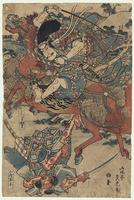
Oguri Hangan Sukeshige and Yamasaki
Utagawa Sadatora
Kyumonryu Shinshin and Chokanko Chintasu
Utagawa Kuniyoshi
Grab Tengu Nose
Tsukioka Yoshitoshi
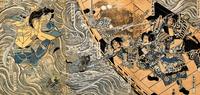
The ghost of Taira Tomomori
Utagawa Kuniyoshi
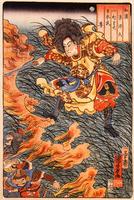
Yamamoto Takeru no Mikoto between burning grass
Utagawa Kuniyoshi
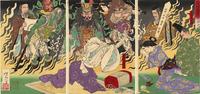
The Fever
Tsukioka Yoshitoshi
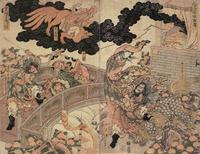
Sangoku Yōko den
Katsushika Hokusai
Tsuchiyama
Utagawa Kuniyoshi
Tammeijiro Genshogo, from Tsuzoku Suikoden Goketsu Hyakuhachinin no Hitori
Utagawa Kuniyoshi
Otsu-e Paintings Coming Alive Triptych
Utagawa Kuniyoshi
Konseimao hanzui beset by demons
Utagawa Kuniyoshi
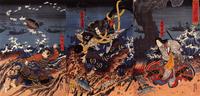
Tamomori tied to a huge anchor ready to cast himself into the sea
Utagawa Kuniyoshi
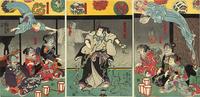
The Ghosts
Utagawa Kuniyoshi
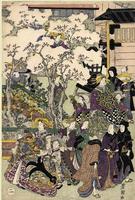
The Promenade
Utagawa Toyokuni
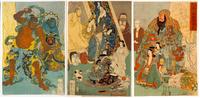
The Famous Unrivalled Hidari Jingoro
Utagawa Kuniyoshi
Overview of the kabuki play Yoshitsune Senbon Zakura (Yoshitsune and the thousand cherry trees)
Utagawa Sadatora
鬼趣图
Qian Xuan