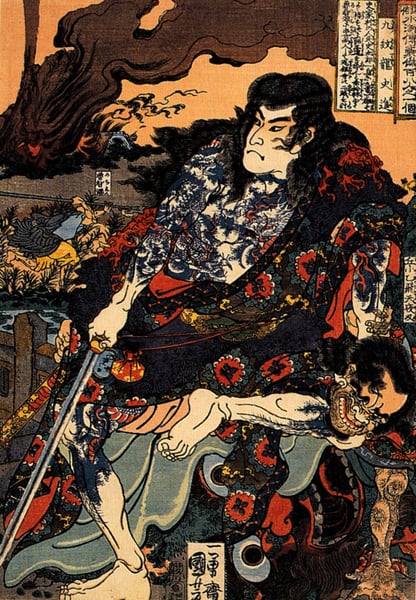
Kyumonryu Shinshin and Chokanko Chintasu
Expertenanalyse zu Utagawa Kuniyoshis Kyumonryu Shinshin and Chokanko Chintasu
Stil: Ukiyo-e · Genre: battle painting
As an expert art historian, I will analyze "Kyumonryu Shinshin and Chokanko Chintasu" by Utagawa Kuniyoshi based solely on the provided facts: Ukiyo-e style and battle painting genre.
Significance in Ukiyo-e and the Battle Painting Genre
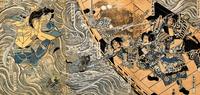
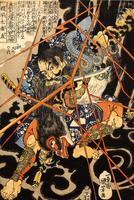
This work is significant as a prime example of Utagawa Kuniyoshi’s mastery within the ukiyo-e tradition of musha-e (warrior prints), a subcategory of the battle painting genre. Kuniyoshi was renowned for his dynamic, muscular compositions and vivid storytelling, which elevated the depiction of historical and legendary combat beyond mere documentation into dramatic, almost cinematic spectacle.
The title itself—featuring the names Kyumonryu Shinshin and Chokanko Chintasu—suggests a scene derived from Chinese legend or Japanese adaptations of Chinese folklore (specifically the Shuihu Zhuan / Suikoden tales, which Kuniyoshi often illustrated). The specific combination of these two figures implies a moment of intense confrontation or heroic alliance, a hallmark of Kuniyoshi’s warrior prints.
What makes this piece significant within the ukiyo-e canon is Kuniyoshi’s departure from the more static, decorative style of earlier ukiyo-e masters. His battle scenes are characterized by:
- Extreme foreshortening and contorted poses, emphasizing the physical strain and violence of combat.
- Bold, flowing lines (often derived from traditional kanga Chinese-style painting) that animate the figures and their weaponry.
- Vibrant, saturated pigments (especially Prussian blue, which he championed) that heighten dramatic contrast.
- Use of texture (e.g., rope, armor, and fur) to create a tactile sense of realism within the flat woodblock print medium.
In the context of 19th-century Japan, Kuniyoshi’s battle prints were hugely popular because they fused historical gravitas with visceral action, appealing to a samurai-class nostalgic for martial valor and a commoner class hungry for thrilling narratives. This work, like many of his finest, represents the peak of ukiyo-e’s ability to convey raw, physical energy—influencing later Western artists (such as Van Gogh and Toulouse-Lautrec) who admired his compositional audacity. It stands as a testament to Kuniyoshi’s role in revitalizing the battle painting genre by infusing it with psychological intensity and technical bravura.
Visuell ähnlich
20 Werke mit ähnlicher Komposition und Farbpalette
Shutsudoko Doi
Utagawa Kuniyoshi
Roshi Ensei lifting a heavy beam
Utagawa Kuniyoshi
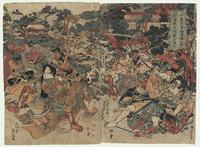
Oguri Hangan Sukeshige in Battle
Utagawa Sadatora
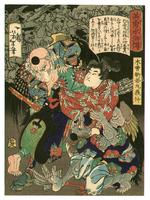
Grab Tengu Nose
Tsukioka Yoshitoshi
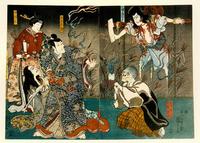
The Ghosts of Togo and His Wife
Utagawa Kuniyoshi
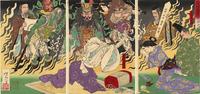
The Fever
Tsukioka Yoshitoshi
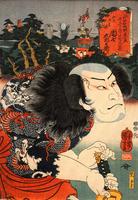
The actor
Utagawa Kuniyoshi
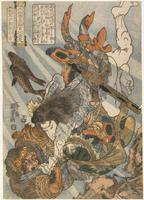
Tammeijiro Genshogo, from Tsuzoku Suikoden Goketsu Hyakuhachinin no Hitori
Utagawa Kuniyoshi
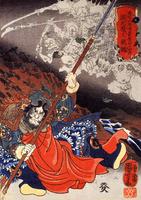
Konseimao hanzui beset by demons
Utagawa Kuniyoshi
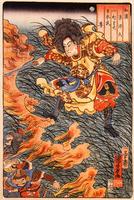
Yamamoto Takeru no Mikoto between burning grass
Utagawa Kuniyoshi
Yoshi tomigoro
Tsukioka Yoshitoshi
The Hundred and Eight Heroes of the Popular Suikoden
Utagawa Kuniyoshi
Kamigashihime stabbing a giant spider
Utagawa Kuniyoshi
The Ghosts
Utagawa Kuniyoshi
A man confronted with an apparition of the Fox goddess
Utagawa Kuniyoshi
Sumo Wrestlers
Katsushika Hokusai
Oguri Hangan Sukeshige and Yamasaki
Utagawa Sadatora
The Underwater Fight
Tsukioka Yoshitoshi
The ghost of Taira Tomomori
Utagawa Kuniyoshi
Li Hayata Hironao grappling with the monster
Utagawa Kuniyoshi