Gustave Loiseau sanatçısının Landscape in Winter with Fog eseri hakkında uzman analizi
Tarz: Post-Impressionism · Tür: landscape
Expert Analysis of "Landscape in Winter with Fog" by Gustave Loiseau
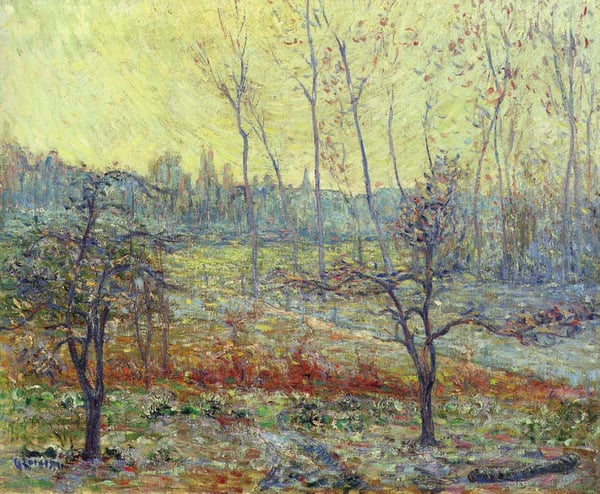
Gustave Loiseau’s Landscape in Winter with Fog exemplifies the Post-Impressionist emphasis on subjective expression and structural harmony, while also showcasing his distinctive mastery of atmospheric effects. Painted during a period when many Post-Impressionists were moving beyond the spontaneous light-capturing of Impressionism, Loiseau’s work stands out for its deliberate, rhythmic brushwork and its nuanced handling of a challenging, monochromatic subject: winter fog.
Significance within Post-Impressionism:
Loiseau is often celebrated as a bridge between Impressionism and later modernist tendencies. In this landscape, he employs short, hatched strokes (a technique sometimes called “en treillis” or cross-hatching) that are neither purely pointillist nor freely Impressionist. Instead, these strokes build a dense, fabric-like surface that gives the fog a palpable, almost tactile weight. The palette is deliberately subdued—muted grays, silvery whites, and faint blues—but Loiseau introduces subtle warm notes (pale ochre or rose) to suggest the sun struggling through the mist. This controlled color harmony is a hallmark of Post-Impressionism’s move toward emotional and symbolic resonance over naturalistic fidelity.
Atmospheric Innovation:
Fog is notoriously difficult to paint because it eliminates hard edges and strong contrasts. Loiseau embraces this challenge by dissolving the horizon line and reducing the landscape to soft, overlapping planes. The trees and distant hills emerge not as solid forms but as veiled masses, their contours defined only by slight variations in tone and brush direction. This technique anticipates the more abstract atmospheric studies of later artists, while remaining anchored in the physicality of paint. The work’s significance lies in how it makes the invisible visible—transforming a climatic condition into a compositional principle.
Legacy and Context:
Loiseau was a regular at the Salon des Indépendants and associated with the Pont-Aven group, but he resisted codified systems (like Seurat’s strict divisionism). Landscape in Winter with Fog thus represents a personal synthesis: it retains the plein-air freshness of Impressionism while advancing a more deliberate, constructed surface that emphasizes the artist’s hand. In its quiet, almost melancholic atmosphere, the painting also reflects the fin-de-siècle fascination with transient, atmospheric moments—a theme that connects Loiseau to Symbolist currents.
Conclusion:
This work is significant not for bold innovation but for its refined execution of a difficult subject within the Post-Impressionist idiom. It demonstrates how Loiseau used controlled brushwork, a limited palette, and a deep sensitivity to weather to elevate a simple winter landscape into a meditation on perception and materiality. It stands as a testament to Post-Impressionism’s ability to find profound beauty in the ordinary, obscured by fog.
Museum / Gallery
Görsel olarak benzer
İlişkili kompozisyon ve renk paletine sahip 20 eser
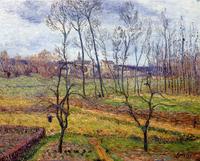
Overcast Weather at Nesles la Vallee
Gustave Loiseau
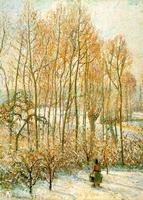
Morning Sunlighton the Snow, Eragny-sur-Epte
Camille Pissarro
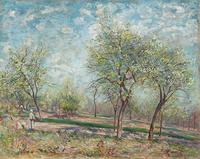
Apple Trees in Bloom
Alfred Sisley
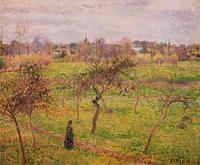
The Meadow at Eragny
Camille Pissarro
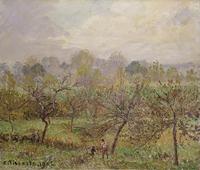
Autumn, Morning Mist, Éragny-sur-Epte
Camille Pissarro
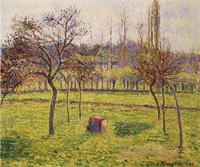
Apple Trees in a Field
Camille Pissarro
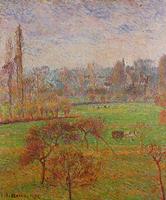
Autumn Morning
Camille Pissarro
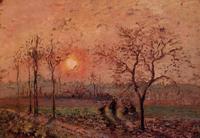
Sunset
Camille Pissarro
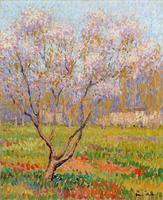
Trees in Bloom
Henri Martin
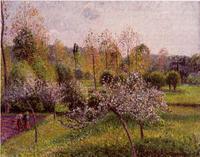
Flowering Apple Trees, Eragny
Camille Pissarro
Belkino. Garden.
Pyotr Konchalovsky
An Apple Tree at Eragny
Camille Pissarro
Near Saint Cyr
Gustave Loiseau
Springtime
Claude Monet
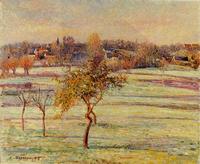
White Frost at Eragny
Camille Pissarro
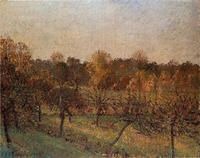
Sunset at Eragny
Camille Pissarro
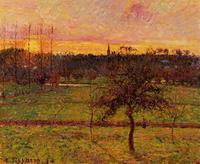
Landscape at Eragny
Camille Pissarro
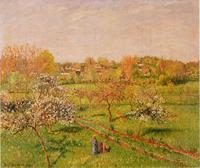
Morning, Flowering Apple Trees, Eragny
Camille Pissarro
Flowering Garden in Spring
Henri Martin
The Furrows
Alfred Sisley