Expert analysis of Gustave Loiseau’s Paper Mill at Port Marly
Style: Post-Impressionism · Genre: landscape
Expert Analysis of "Paper Mill at Port Marly" by Gustave Loiseau
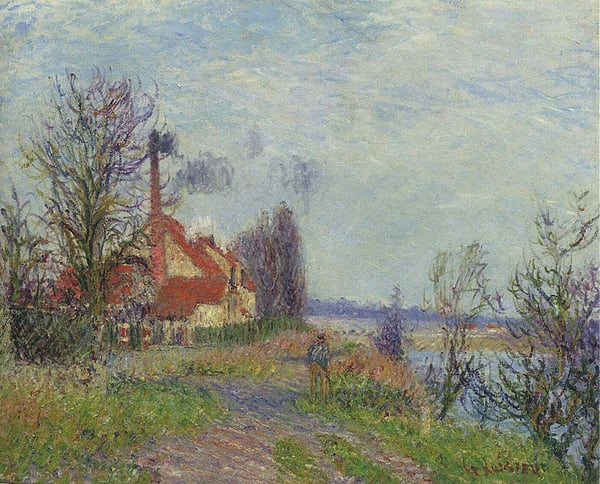
Gustave Loiseau’s Paper Mill at Port Marly exemplifies the Post-Impressionist commitment to capturing atmospheric nuance while moving beyond the spontaneous naturalism of Impressionism. As a landscape painted in the late 19th or early 20th century, this work demonstrates Loiseau’s distinctive method of applying paint in rhythmic, cross-hatched brushstrokes—a technique he called en treillis (trellis-like). This approach gives the canvas a vibrant, woven texture that simultaneously suggests the shimmer of light on water and the solid mass of industrial architecture.
The significance of this painting lies in its balance between modern subject matter and lyrical vision. Port Marly, a village on the Seine west of Paris, was home to a paper mill—a fact that embeds the landscape in the era’s industrial transformation. Loiseau, however, does not treat the mill as a mere documentary record. Instead, he integrates it into a serene pastoral scene, using his structured brushwork to unify the chimney, rooftops, and trees with the river’s reflections. This synthesis reflects a core Post-Impressionist ambition: to infuse everyday scenes with a sense of enduring order and emotional resonance.
Loiseau’s work is often placed within the orbit of the Pont-Aven School, alongside artists like Paul Gauguin and Émile Bernard, yet Paper Mill at Port Marly shows his distinct path. Where Gauguin sought symbolic, flattened forms, Loiseau remains devoted to the observed world, but his en treillis strokes impose a rigorous, almost architectural rhythm that recalls the tapestries of the region. This technique allows him to capture the fleeting effects of sunlight—the dappled dance on the water, the hazy silhouette of the mill—while giving the composition a sturdy, decorative permanence.
Ultimately, this painting is significant for how it pushes Impressionism’s legacy into a more deliberate, constructionist phase. Loiseau demonstrates that a landscape can be both a faithful transcript of a specific place and a carefully orchestrated pattern of color and stroke. Paper Mill at Port Marly stands as a testament to Post-Impressionism’s enduring interest in the marriage of sensory experience and formal structure, solidifying Loiseau’s role as a master of lyrical, textured landscapes.
Visually similar
20 works with related composition and palette
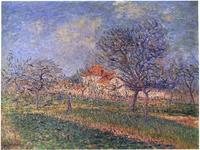
Trees in Bloom
Gustave Loiseau
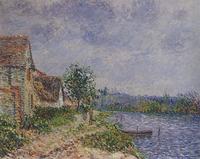
Port Joie
Gustave Loiseau
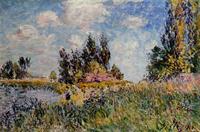
Landscape The Banks of the Loing at Saint Mammes
Alfred Sisley
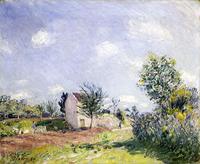
Springtime
Alfred Sisley
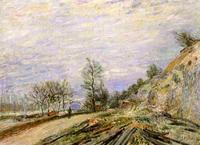
On the Road from Moret
Alfred Sisley
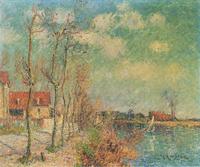
By the Oise River
Gustave Loiseau
Path near Sevres
Alfred Sisley
Hill Path
Alfred Sisley
Saint Mammes
Alfred Sisley
Snow Rifts Near the Seine
Gustave Loiseau
House at Beynac
Gustave Loiseau
Tournedos sur Seine
Gustave Loiseau
Edge of Fountainbleau Forest June Morning
Alfred Sisley
Moret, Route of Pres
Francis Picabia
Small Meadows in Spring
Alfred Sisley
The Riverbank at Petit-Gennevilliers
Claude Monet
Autunm in Eragny
Camille Pissarro
Path at Sablons
Alfred Sisley
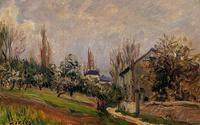
Near Moret
Alfred Sisley
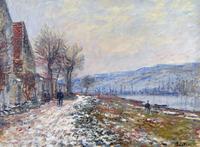
The Siene at Lavacourt, Effect of Snow
Claude Monet