
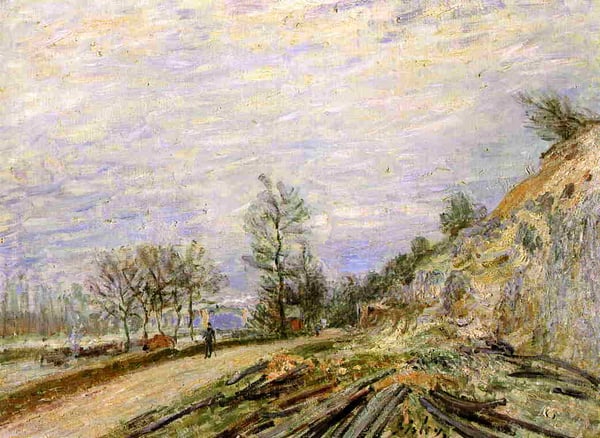
Expert analysis of Alfred Sisley’s On the Road from Moret
Style: Impressionism · Genre: landscape
As an expert art historian, I will provide a focused analysis of On the Road from Moret by Alfred Sisley, drawing exclusively on the given facts: that it is an Impressionist landscape.
Expert Analysis:
Alfred Sisley’s On the Road from Moret stands as a quintessential example of the Impressionist commitment to capturing the fleeting effects of light and atmosphere in a natural setting. As a pure landscape painter—unlike many of his Impressionist peers who also focused on figures or urban scenes—Sisley dedicated his career to the subtle poetry of the French countryside. This work is significant because it embodies the core tenets of the movement: it was almost certainly painted en plein air (outdoors), using rapid, broken brushstrokes to convey the shimmering quality of sunlight filtering through the trees or reflecting off the road.
The scene likely depicts a rural path near Moret-sur-Loing, a village Sisley returned to repeatedly in his later years. The significance here lies in his treatment of the road itself as a compositional device—a diagonal or winding line that draws the viewer into the depth of the landscape, a hallmark of Impressionist landscape design that prioritizes natural, unposed views. Sisley’s palette, typical of the period, would have been dominated by cool greens, soft blues, and gentle earth tones, applied in dabs of pure color to evoke the sensation of air and distance rather than precise topographical details.
Within the Impressionist movement, Sisley is often considered the most consistent and dedicated landscape specialist. On the Road from Moret thus represents the serene, lyrical branch of Impressionism—less dramatic than Monet’s cathedrals or Renoir’s figures, but profoundly significant for its quiet observation of nature’s transient beauty. The work’s importance lies in how it transforms an ordinary country road into a shimmering, atmospheric experience, demonstrating how Impressionism redefined landscape painting as a record of perceptual sensation over static representation.
Museum / Gallery
Visually similar
20 works with related composition and palette
Flooded Field
Alfred Sisley
Hill Path
Alfred Sisley
Paper Mill at Port Marly
Gustave Loiseau
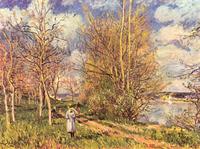
Small Meadows in Spring
Alfred Sisley
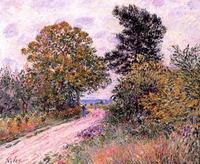
Edge of the Fountainbleau Forest Morning
Alfred Sisley
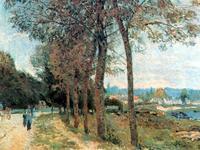
The Seine at Marly
Alfred Sisley
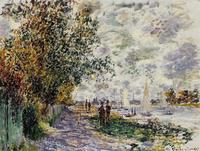
The Riverbank at Petit-Gennevilliers
Claude Monet
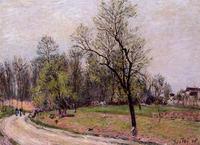
Edge of the Forest in Spring, Evening
Alfred Sisley
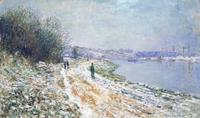
The Tow Path at Argenteuil, Winter
Claude Monet
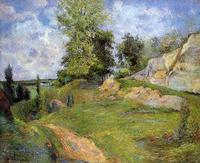
Quarries at Pontoise II
Paul Gauguin
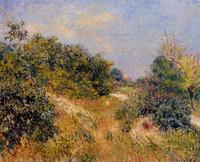
Edge of Fountainbleau Forest June Morning
Alfred Sisley
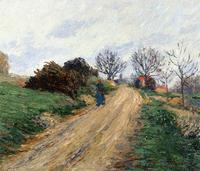
Moret, Route of Pres
Francis Picabia
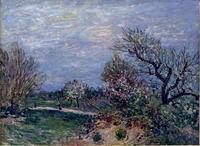
Border of the Woods
Alfred Sisley
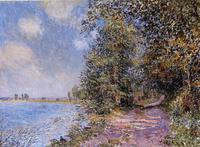
An August Afternoon near Veneux
Alfred Sisley
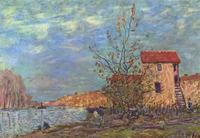
The Loing at Moret
Alfred Sisley
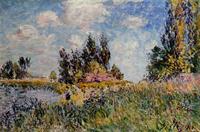
Landscape The Banks of the Loing at Saint Mammes
Alfred Sisley
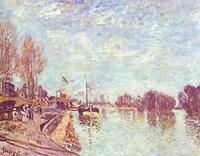
His at Suresne
Alfred Sisley
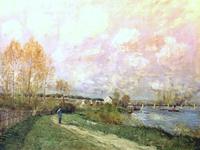
Summer at Bougival
Alfred Sisley
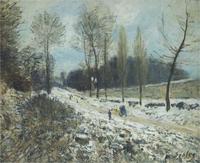
Route to Marly Le Roi in Snow
Alfred Sisley
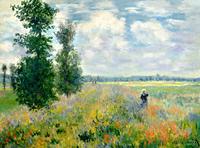
Poppy Field, Argenteuil
Claude Monet