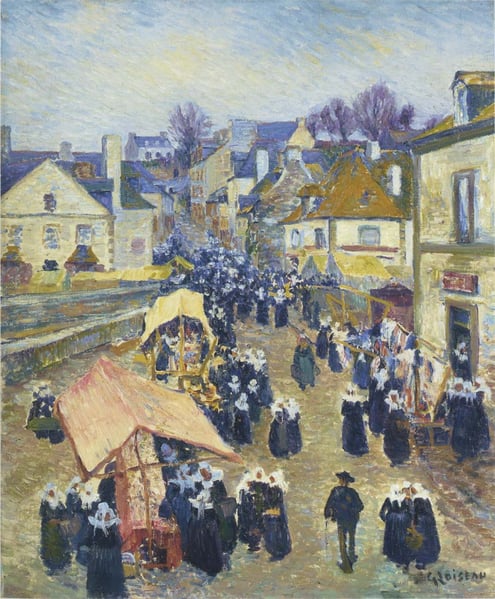
Street at Pont Aven
Expert analysis of Gustave Loiseau’s Street at Pont Aven
Style: Post-Impressionism · Genre: cityscape
Expert Analysis of "Street at Pont Aven" by Gustave Loiseau
As a Post-Impressionist cityscape, Gustave Loiseau's Street at Pont Aven holds significance through its embodiment of the movement's core ambition: to move beyond Impressionism's fleeting optical effects toward a more structured, expressive representation of reality. While we are not provided with a specific date or medium, Loiseau's known association with the Pont-Aven School—a group of artists gathered around Paul Gauguin in the late 1880s—roots this work in a historic crucible of artistic innovation.
Significance within Post-Impressionism:
-
Synthesis of Observation and Structure
Loiseau's street scene captures the particular atmosphere of Pont-Aven, a Breton village that became a laboratory for Post-Impressionist experimentation. Unlike pure Impressionism, which might dissolve the scene into shimmering light, Loiseau organizes the composition with a deliberate sense of rhythm and pattern. The handling of forms—likely through short, hatched brushstrokes—suggests a personal, tactile response to the architecture and daily life, aligning with Post-Impressionism's emphasis on the artist's subjective vision over mere transcription. -
Color and Emotion
Post-Impressionists employed color not only as a descriptive tool but as a carrier of mood and symbolic weight. Loiseau's palette in this cityscape would typically favour tempered, earthy tones punctuated by saturated accents, reflecting the muted yet vibrant character of the Breton landscape. This approach distances the work from the high-keyed palette of earlier Impressionism and aligns with the Synthetist ideals of Gauguin’s circle, where colour became a means of emotional and formal synthesis. -
Ordinary Subject, Elevated Treatment
The choice of a humble village street—rather than a grand boulevard or tourist spectacle—speaks to the Post-Impressionist interest in the authentic, the local, and the timeless. Loiseau elevates this everyday scene through careful attention to the interplay of light, shadow, and architectural geometry. In doing so, he participates in the broader Post-Impressionist revaluation of subject matter, where a simple street could carry the same artistic weight as a mythological scene. -
Bridge Between Movements
Loiseau’s oeuvre is often seen as a link between Impressionism and the more radical formal experiments of the early twentieth century. Street at Pont Aven exemplifies this transitional quality: it retains the loose brushwork and plein-air freshness of Impressionism but introduces a firmer compositional scaffolding and a more deliberate emotional resonance that prefigures Expressionist tendencies.
Conclusion:
This painting is significant not because it breaks startling new ground, but because it epitomizes Post-Impressionism’s quiet revolution. In Street at Pont Aven, Loiseau takes a familiar locale and recasts it through a personal, disciplined lens—demonstrating how Post-Impressionist cityscapes could transform the ordinary into a site of pictorial and emotional coherence. It stands as a testament to the movement’s enduring pursuit of truth through structure, colour, and subjective vision.
Visually similar
20 works with related composition and palette
Pont Aven, Grey Weather
Gustave Loiseau
Pont Aven
Gustave Loiseau
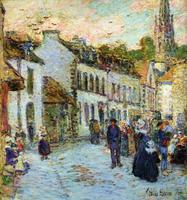
An Evening Street Scene, Pont Aven
Childe Hassam
Mill at Pont Aven
Gustave Loiseau
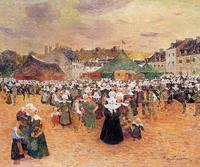
The Fair at Pont-aven
Ferdinand du Puigaudeau
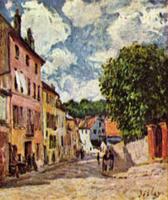
Street in Moret Sur Loing
Alfred Sisley
Street in Marly
Alfred Sisley
Village Street Grey Weather
Alfred Sisley
The Old Rue de la Chaussee, Argenteuil
Claude Monet
First Snow in Louveciennes
Alfred Sisley
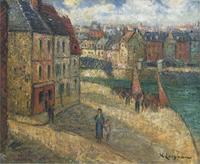
Quay at Dieppe
Gustave Loiseau
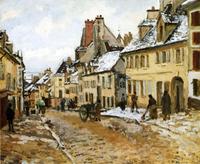
Pontoise, the Road to Gisors in Winter
Camille Pissarro
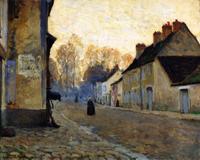
Rue du Canal, Moret-sur-Loing
Clarence Gagnon
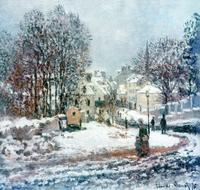
The Grand Street Entering to Argenteuil, Winter
Claude Monet
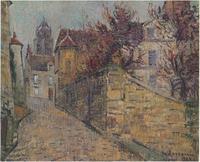
House of the Sisters in Pontoise
Gustave Loiseau
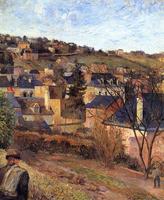
Blue roofs of Rouen
Paul Gauguin
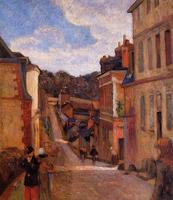
Rue Jouvenet, Rouen
Paul Gauguin
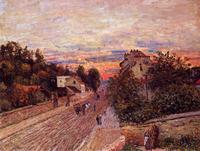
Sunset at Port Marly
Alfred Sisley
Fervaques, the Main Street
Eugene Boudin
The Port of Palais, Belle Ile
Henri Matisse