Expert analysis of Gustave Loiseau’s The Seine at Port Marly
Style: Post-Impressionism · Genre: landscape
Expert Analysis: "The Seine at Port Marly" by Gustave Loiseau (Post-Impressionism)
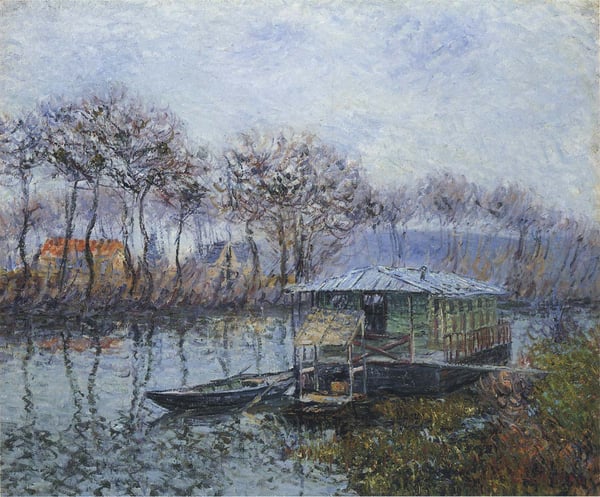
Gustave Loiseau’s The Seine at Port Marly is a quintessential Post-Impressionist landscape that captures the transitional moment between Impressionism’s fleeting light effects and the more structured, expressive approach of later avant-garde movements. Painted en plein air, the work demonstrates Loiseau’s hallmark technique of dense, rhythmic brushstrokes—often compared to both Claude Monet’s serial river scenes and Vincent van Gogh’s vibrant impasto—yet with a deliberate, almost architectural ordering of form.
Significance within Post-Impressionism:
While Loiseau was deeply influenced by the Impressionists’ focus on natural light and atmospheric conditions, he pushed beyond their gentle dissolution of form. In this painting, the Seine’s surface is built from short, distinct dabs of color that lock together into a woven tapestry of blues, greens, and golden reflections. This “cross-hatched” brushwork gives the water and sky a palpable, vibrating texture, while the riverbanks, trees, and distant houses retain clear outlines—a structural firmness that distinguishes his work from pure Impressionist spontaneity.
Genre and Landscape Tradition:
Port Marly, a village near Paris where the Seine curves through meadows and poplars, was a favored subject for Loiseau, who returned to it multiple times to study seasonal and temporal changes. Here, the composition is anchored by a strong diagonal: the riverbank leads the eye from the lower left into the distance, where a low horizon emphasizes the expansive sky. This balanced, almost panoramic design recalls the classical landscape tradition, but Loiseau’s heightened palette—with unexpected touches of mauve, terracotta, and emerald—infuses the scene with a modern, subjective emotional charge.
Art Historical Context:
Loiseau exhibited with the Société des Artistes Indépendants and was championed by the dealer Durand-Ruel, yet he remained somewhat outside the more radical experiments of Fauvism and Cubism. The Seine at Port Marly exemplifies his “crosshatch” period (circa 1900–1910), during which he systematized his brushwork into a personal, decorative idiom. This approach directly influenced later painters seeking to unite color with rhythmic form—a legacy that places Loiseau as an important, if understated, bridge between Impressionist observation and the more overt stylizations of early 20th-century modernism.
Conclusion:
The significance of this artwork lies in its mastery of structural harmony through visible, energetic brushwork. Loiseau transforms a serene river scene into a vibrant surface pattern without losing the sense of air and light—a testament to Post-Impressionism’s dual commitment to nature and personal expression. The Seine at Port Marly stands as a refined example of how landscape painting could evolve from fleeting sensation into enduring architectural color.
Visually similar
20 works with related composition and palette
Washerwomen of Bougival
Alfred Sisley
Spring on the Loing River
Alfred Sisley
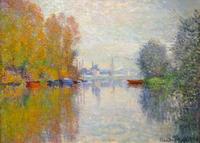
Autumn on the Seine at Argenteuil
Claude Monet
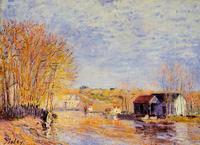
High Waters at Moret sur Loing
Alfred Sisley
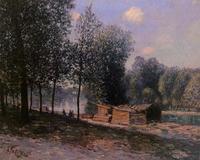
Cabins by the River Loing, Morning
Alfred Sisley
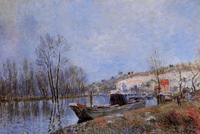
Banks of the Loing towards Moret
Alfred Sisley
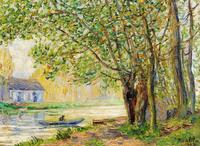
The Effect of Sun on the Banks of the Loing
Francis Picabia
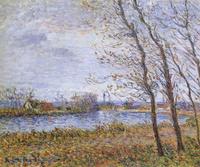
Port Pinche at the Turn of the Seine
Gustave Loiseau
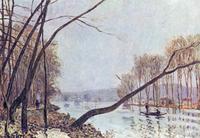
Bank, in the autumn
Alfred Sisley
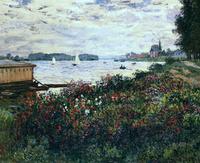
Riverbank at Argenteuil
Claude Monet
By the Eure River in Summer
Gustave Loiseau
Washhouse at lower meudon
Pierre-Auguste Renoir
Banks of the Oise
Paul Gauguin
Seine at Bougival
Alfred Sisley
The Banks of the Seine in Autumn flood
Alfred Sisley
By the Eure River
Gustave Loiseau
Banks of the Loing, Winter
Alfred Sisley
Paris, Ponton des Bains Bailet
Paul Signac
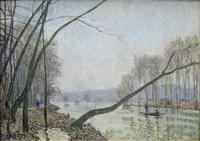
The Banks of the Seine in Autumn
Alfred Sisley
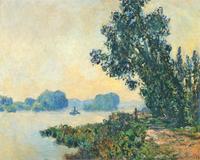
The Towpath at Granval
Claude Monet