Expertenanalyse zu Paul Gauguins Banks of the Oise
Stil: Impressionism · Genre: landscape
Expert Analysis: "Banks of the Oise" by Paul Gauguin
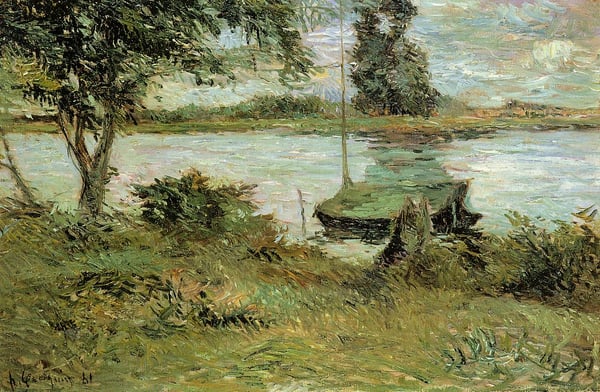
Paul Gauguin’s Banks of the Oise belongs to his early works, a period when he was still deeply immersed in the Impressionist movement under the influence of Camille Pissarro. Painted in the late 1870s or early 1880s, this landscape captures a stretch of the Oise River near Pontoise, a favored site for Impressionist plein-air painting.
Significance within Impressionism and Gauguin’s Evolution
- Mastery of Impressionist Technique: The work exemplifies core Impressionist principles—loose, visible brushstrokes, a bright palette dominated by greens, blues, and soft earth tones, and an emphasis on capturing ephemeral light effects. The river’s surface shimmers with broken touches of paint, reflecting the sky and foliage.
- Transitional Character: While fully within the Impressionist idiom, the painting already reveals Gauguin’s later tendencies: a simplification of forms and a slight flattening of spatial depth. Unlike the more atmospheric works of Monet or Sisley, Gauguin’s composition is structured with clear horizontal bands (riverbank, water, distant hills), hinting at the synthesized, decorative quality that would define his Post-Impressionist and Symbolist phases.
- Pissarro’s Influence: Gauguin worked alongside Pissarro in Pontoise, adopting his friend’s muted, earthy palette and systematic brushwork. Yet Banks of the Oise shows Gauguin beginning to push beyond pure observation—the trees are rendered with a bold, almost abstract sense of pattern, foreshadowing his later move away from naturalism.
Art-Historical Importance
This painting is significant as a snapshot of Gauguin’s artistic origins—before his break with Impressionism, his journeys to Brittany and Tahiti, and his radical innovations in color and symbolism. It demonstrates that even within the confines of a conventional Impressionist landscape, Gauguin was already experimenting with the expressive power of form and hue that would make him a pioneer of modern art. Banks of the Oise thus serves as both a beautiful example of late Impressionism and a crucial document of an artist on the cusp of transformation.
Museum / Gallery
Visuell ähnlich
20 Werke mit ähnlicher Komposition und Farbpalette
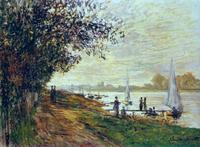
The Riverbank at Petit-Gennevilliers, Sunset
Claude Monet
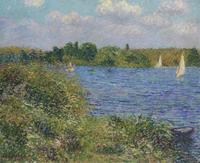
Port Joie at the Seine
Gustave Loiseau
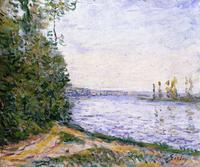
The Seine near By
Alfred Sisley
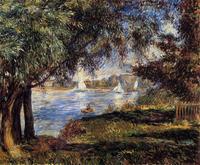
Bougival
Pierre-Auguste Renoir
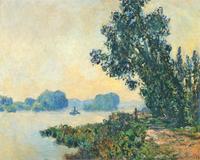
The Towpath at Granval
Claude Monet
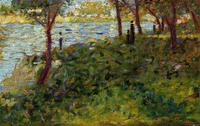
Landscape with Figure. Study for 'La Grande Jatte'
Georges Seurat
An August Afternoon near Veneux
Alfred Sisley
River Landscape by Moret sur Loing
Alfred Sisley
Sailboat
Georges Seurat
Late Afternoon (aka Sunset)
Childe Hassam
By the Lorne River near Caen
Gustave Loiseau
Moret Sur Loing
Alfred Sisley
The fishermen
Maxime Maufra
Landscape The Banks of the Loing at Saint Mammes
Alfred Sisley
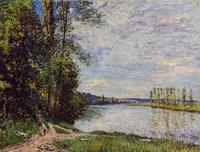
The Path from Veneux to Thomery along the Water, Evening
Alfred Sisley
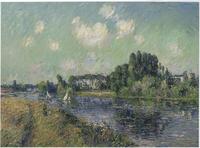
Sails on the Oise
Gustave Loiseau
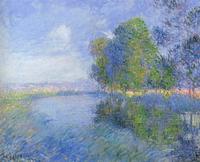
Trees in Bloom
Gustave Loiseau
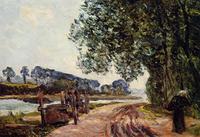
The Banks of the River Auray
Maxime Maufra
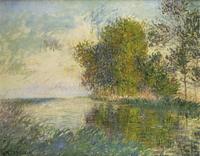
The Normandy River
Gustave Loiseau
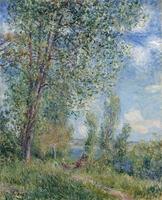
Windy Afternoon in May
Alfred Sisley