Expert analysis of Guy Rose’s The Saine Valley, Giverny
Style: Impressionism · Genre: landscape
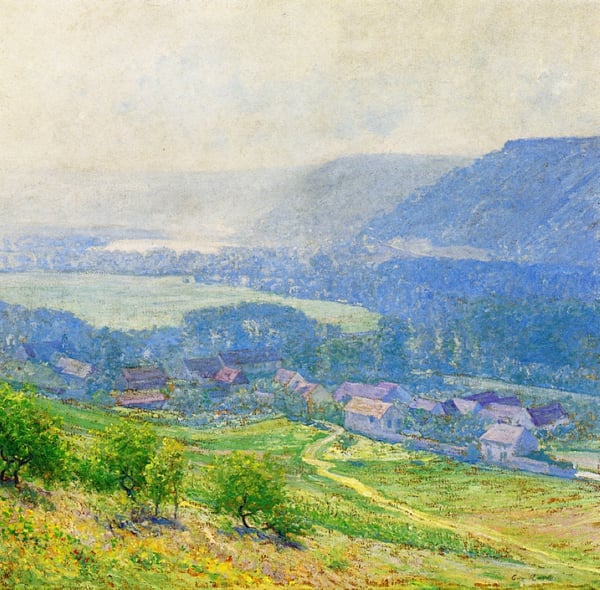
Expert Art Historical Analysis: "The Seine Valley, Giverny" by Guy Rose
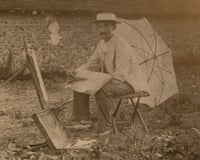
Guy Rose’s The Seine Valley, Giverny stands as a compelling example of American Impressionism’s dialogue with its French origins, while simultaneously asserting a distinctively personal vision. Executed during Rose’s sojourn in France, the work captures a view of the Seine River valley near the village of Giverny—the very landscape that had profoundly shaped Claude Monet’s late series. Rose, who studied at the Académie Julian and later became a leading figure of the California Impressionist school, brings to this scene a synthesis of European plein-air technique and a refined, luminous palette that prefigures his later West Coast work.
Significance within Impressionism:
-
Cross-Cultural Synthesis: The painting bridges French and American Impressionism. Rose absorbed Monet’s broken brushwork and atmospheric sensitivity (evident in the dappled light on the valley slopes and the shimmering water), yet retains a firm structural clarity and a slightly cooler tonality that recalls the California light he would later champion. This makes the work a key transitional piece in the diffusion of Impressionist ideals across the Atlantic.
-
Giverny as a Symbol: By choosing the Seine Valley at Giverny, Rose directly engages with the locus classicus of High Impressionism. However, rather than replicating Monet’s iconic haystacks or water lilies, he offers a broader, more panoramic view—emphasizing the sweeping rhythm of the river and the valley’s layered terrain. This demonstrates an independent eye, asserting that the American painter could claim this sacred ground for his own exploration of light, atmosphere, and fleeting sensation.
-
Technical Mastery: Rose’s brushwork in this landscape is both delicate and assertive. Short, dappled strokes convey the shimmer of foliage and the reflective quality of the Seine, while the subtle gradations of green, blue, and lavender in the distant hills reveal a nuanced understanding of aerial perspective. The composition is balanced between the immediate foreground (perhaps a bank or path) and the expansive valley, guiding the viewer’s eye along the river’s gentle curve—a hallmark of Impressionist landscape design that prioritizes optical experience over narrative.
In sum, The Seine Valley, Giverny is not merely a picturesque view; it is a testament to Guy Rose’s ability to interpret the essence of Impressionism through a distinctly American sensibility. It stands as an important document of artistic exchange at the turn of the century, demonstrating how a foreign artist could internalize the lessons of Giverny and later adapt them to new landscapes, thereby expanding the movement’s global reach.
Visually similar
20 works with related composition and palette
The Terrace at Saint Germain, Spring
Alfred Sisley
The Valley of the Seine
Guy Rose
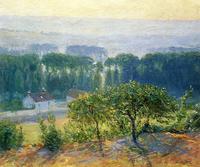
Late Afternoon Giverny
Guy Rose
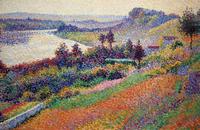
The Seine At Herblay
Maximilien Luce
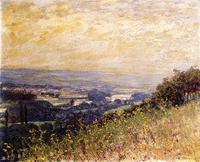
The Distant Town
Guy Rose
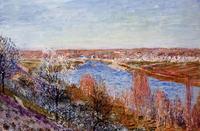
Village of Champagne at Sunset April
Alfred Sisley
Landscape
Theodore Robinson
August Noon
Guy Rose
Valley of the Seine, from the Hills of Giverny
Theodore Robinson
Autumn
Mikhail Olennikov
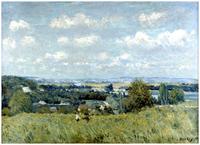
Valley of the Seine at Saint Cloud
Alfred Sisley
Field
Isaac Levitan
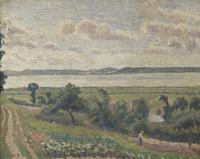
View over the Estuary, Harfleur
Lucien Pissarro
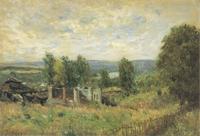
Landscape in Summer
Alfred Sisley
The Thierceville Road, Early Spring
Lucien Pissarro
Landscape
Alfred Sisley
Apple Trees near Vetheuil
Claude Monet
View of Saint Ouen L'Aumone
Camille Pissarro
View over Vetheuil
Claude Monet
Sedniv Vista
Mykhailo Vainshtein