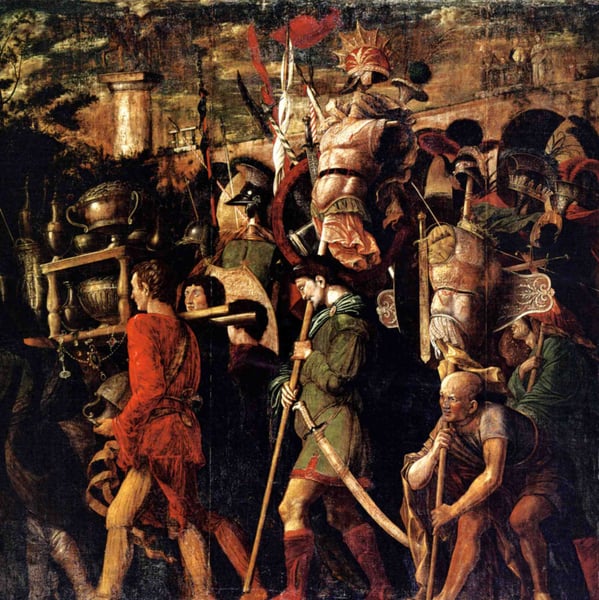
Holders of currencies and gold jewelry, trophies royal armor
Details
Expertenanalyse zu Andrea Mantegnas Holders of currencies and gold jewelry, trophies royal armor
Stil: High Renaissance · Genre: history painting
Expert Analysis of "Holders of currencies and gold jewelry, trophies royal armor" by Andrea Mantegna
Style and Period Context
Andrea Mantegna’s work belongs to the High Renaissance, a period defined by a rigorous pursuit of naturalism, classical revival, and mathematical perspective. Mantegna was a master of trompe-l’œil and foreshortening, often employing dramatic, low-angle viewpoints that make figures and objects seem to project into the viewer’s space. In this painting, the meticulous rendering of currencies, gold jewelry, and trophies reflects the era’s fascination with material wealth as a symbol of power and human achievement—a theme common in history painting, which aimed to convey moral or political narratives through grand, often allegorical scenes.
Significance of the Subject
The title explicitly describes a collection of “holders of currencies and gold jewelry” alongside “trophies royal armor.” As a history painting, this work likely functions as a visual chronicle of conquest or princely virtue. The inclusion of coins and precious objects suggests a commentary on the relationship between economic power and military might—a central concern for Renaissance rulers and patrons. Mantegna’s ability to depict these objects with near-sculptural precision (notice the polished surfaces of armor and the gleam of gold) elevates the painting beyond mere still life into a historical statement: wealth is both the spoils of victory and the foundation of a ruler’s legacy.
Artistic Innovations
Mantegna’s handling of perspective is key to the work’s significance. The trophies and currency are likely arranged in a shallow, stagelike space, with bold foreshortening to create a sense of immediacy—as if the viewer is standing before an actual treasure hoard. This technique, derived from his study of Roman antiquities, anchors the High Renaissance ideal of istoria (narrative painting) in a tangible, almost tactile reality. The play of light across metallic surfaces also demonstrates his mastery of chiaroscuro, lending the objects a weight and presence that reinforce their symbolic importance.
Influence and Legacy
This painting exemplifies how Mantegna bridged the late Gothic love of detail with the High Renaissance drive for harmony and classical order. It stands as a precursor to later history paintings that used accumulations of objects—armor, currency, luxury goods—to tell stories of empire, vanity, or morality. The work’s specific focus on holders of currency (perhaps allegorical figures or hands) suggests an innovative narrative device: the anonymous agents of wealth, hinting at the human systems behind material power. In doing so, Mantegna anticipates themes explored by later Renaissance artists such as Bronzino and Titian.
Visuell ähnlich
20 Werke mit ähnlicher Komposition und Farbpalette
Musicians and teaches Carriers
Andrea Mantegna
Triumphs of Caeser
Andrea Mantegna
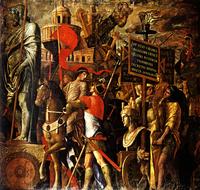
Captured statues and siege equipment, a representation of a captured City and inscriptions (Triumph of Caesar)
Andrea Mantegna
Exaltação da Santa Cruz
Cristovao de Figueiredo
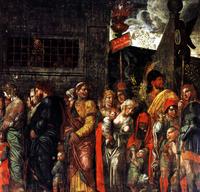
Prisonnniers
Andrea Mantegna
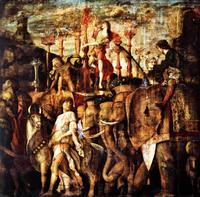
Trumpet players
Andrea Mantegna
Way to Calvary
Albrecht Durer
Saint Paul Conduit À Damas Après Sa Conversion
Pieter Brueghel the Younger
Florian result, scenes for legend of St. Florian
Albrecht Altdorfer
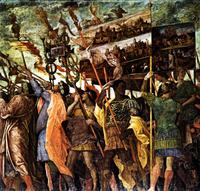
Trumpeters
Andrea Mantegna
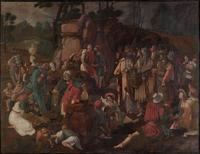
Moses and the Israelites After the Miracle of Water from the Rock
Lucas van Leyden
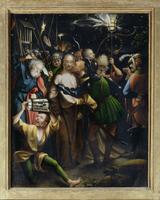
Kiss of Judas
Jan Joest
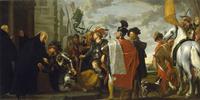
Saint Benedict receiving Totila, King of the Ostrogoths
Gaspar de Crayer
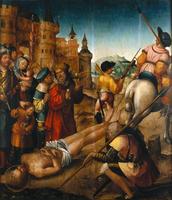
Martírio de Santo Hipólito
Cristovao de Figueiredo
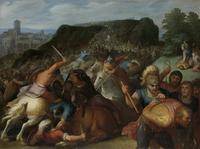
Valentinus Taken Prisoner
Otto van Veen
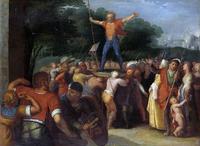
Brinio Raised Upon the Shield
Otto van Veen
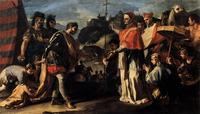
The Meeting of Pope Leo and Attila
Francesco Solimena
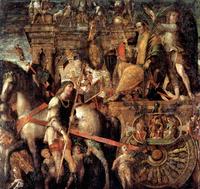
Julius Caesar on a triumphal car
Andrea Mantegna
The Martyrdom of St. Catherine
Lucas Cranach the Elder
Christ before Pilate
Albrecht Durer