Analisi esperta di Mythological Scene, Metamorphoses of Amymone di Andrea Mantegna
Stile: High Renaissance · Genere: mythological painting
Expert Analysis: "Mythological Scene, Metamorphoses of Amymone" by Andrea Mantegna
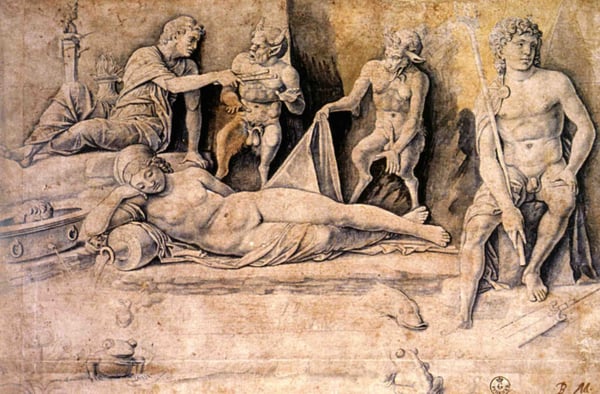
Andrea Mantegna’s Mythological Scene, Metamorphoses of Amymone stands as a quintessential example of the High Renaissance’s fusion of classical narrative with rigorous naturalism. Despite the sparse factual frame provided—High Renaissance style and mythological genre—the work’s significance emerges from Mantegna’s distinctive treatment of the Ovidian myth and his technical mastery.
Classical Precision and Sculptural Form
Mantegna was celebrated for his archaeological approach to antiquity. In this scene, he likely renders Amymone’s metamorphosis (her rescue by Neptune or transformation into a spring) with the monumentality of Roman relief sculpture. Figures are defined by sharp, incised contours and a metallic, almost marble-like modeling of flesh and drapery, reflecting his study of ancient statuary. This sculptural quality, combined with a low horizon and dramatic foreshortening, creates a sense of physical immediacy—a hallmark of Mantegna’s contribution to the High Renaissance emphasis on istoria (narrative action).
Perspective and Spatial Innovation
Mantegna was a pioneering master of perspective. The composition likely employs his signature di sotto in sù (from below upward) viewpoint, pushing the figures into the foreground and collapsing deep space into a shallow stage. This creates a tense, compressed environment that heightens the dramatic interplay between the mortal Amymone and the divine Neptune (or satyr). Such spatial manipulation was radical for its time, influencing later Renaissance artists like Leonardo and Raphael.
Symbolism and Humanist Allegory
The High Renaissance thrived on humanist reinterpretation of myths. Mantegna’s Amymone is not merely a passive victim but a figure of heroic pathos. Her metamorphosis into a life-giving water source (the spring of Lerna) allegorizes the cycle of nature and divine intervention. The inclusion of precise botanical details—reeds, rocky outcrops—anchors the timeless myth in a tangible, observed world, embodying the Renaissance desire to reconcile pagan stories with natural science.
Significance in Period Context
Within the High Renaissance, Mantegna’s work stands as a bridge between the geometric rigor of early Quattrocento Florence and the soft, atmospheric classicism of later Venetian painting. His hard-edged, linear style and archaeological fidelity set him apart from contemporaries like Bellini. This painting, though lesser-known than his Camera degli Sposi or Dead Christ, exemplifies how Mantegna used mythological narrative to explore perspective, human anatomy, and the tension between the ideal and the real—the very concerns that define the High Renaissance achievement.
Visivamente simili
20 opere con composizione e palette affini
Three deities
Andrea Mantegna
Allegory of Fecundity and Abundance
Luca Signorelli
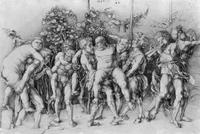
Bacchanal with Silenus
Albrecht Durer
The Dream of Aeneas
Théodore Géricault
Archers shooting at a herm
Michelangelo
Judith with the Head of Holofernes
Andrea Mantegna
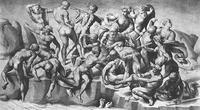
Battle of Cascina (Copy by Michelangelo's pupil Aristotele da Sangallo)
Michelangelo
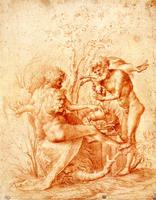
Molorchos making a sacrifice to Hercules
Andrea Mantegna
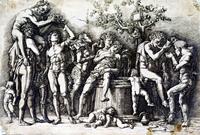
Bacchanalia with a Wine
Andrea Mantegna
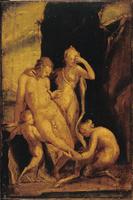
Faun with Wounded Foot
Bartholomeus Spranger
Sketch of figures and scenes from the antique age
Jacopo Bellini
Hector and Andromache
Orest Kiprensky
Baptism of the People
Andrea del Sarto
The Harvesters
Domenico Beccafumi
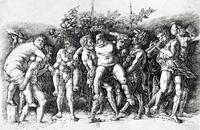
Bacchanal in Silene
Andrea Mantegna
Fortitude, from the Series the Seven Virtues
Lucas van Leyden
Study for a "Holy Family with the Infant St.John"
Michelangelo
Children playing with masks
Andrea Mantegna
Allegory of the Choleric Temperament
Maarten de Vos
Fighting Seekentauren
Albrecht Durer