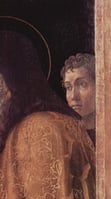
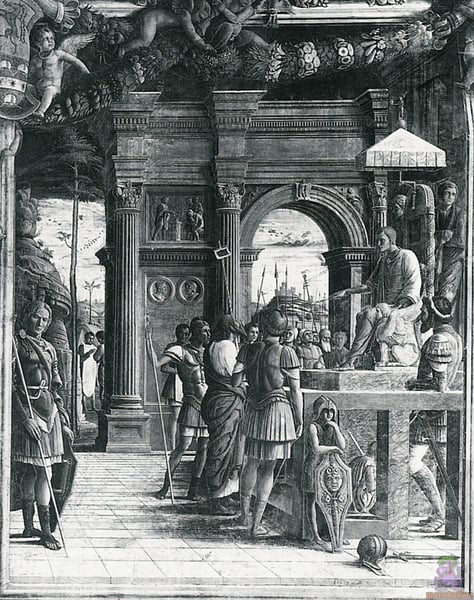
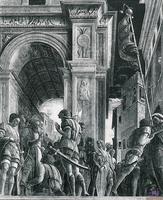
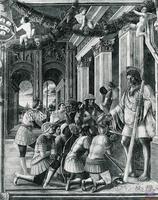
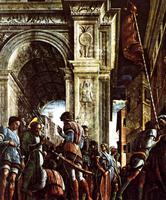
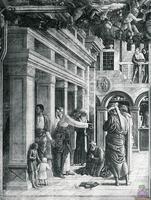
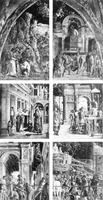
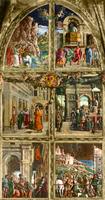
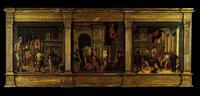
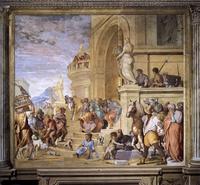
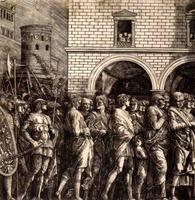
Andrea Mantegna’s “The Trial of St James (Scenes from the Life of St. James)” is a defining work of the Early Renaissance within the religious painting genre. Its significance lies in how Mantegna marries the period’s burgeoning interest in linear perspective and classical antiquity with a powerful, emotionally direct biblical narrative. The scene is composed with rigorous spatial logic—a hallmark of Mantegna’s style—using architectural elements as a stage that both frames the trial and draws the viewer’s eye deep into the picture plane. The figures are sculptural and intensely expressive, their gestures and stances conveying the solemn gravity of the saint’s ordeal. This combination of archaeological precision (in costumes and settings) and psychological realism epitomizes the Early Renaissance ambition to make sacred stories feel immediate, physically grounded, and humanly compelling.