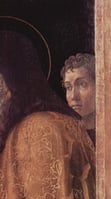
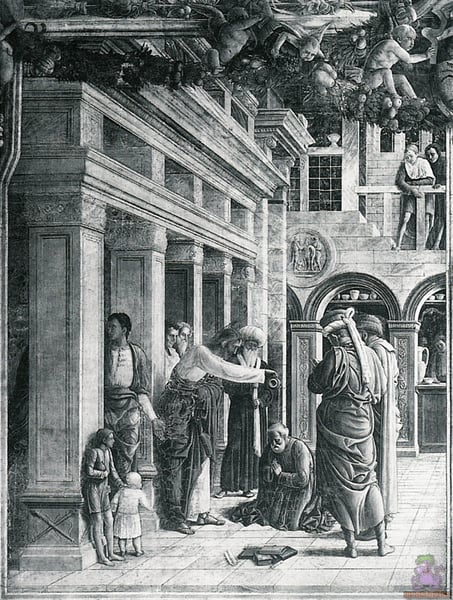
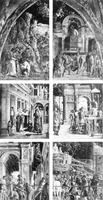
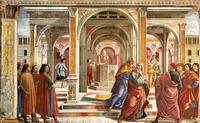
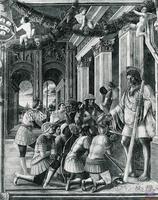
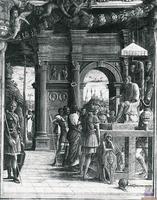
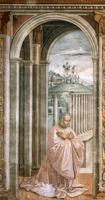
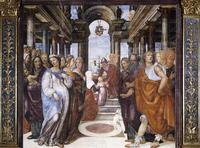
As an Early Renaissance religious painting, Andrea Mantegna’s St James Baptizing Hermogenes (Scenes from the Life of St. James) exemplifies the period’s revolutionary shift toward naturalism, spatial coherence, and classical rigor. The work is significant for its demonstration of Mantegna’s hallmark integration of linear perspective and archaeological precision—qualities central to the Early Renaissance style—within a narrative religious subject. By depicting a moment from the saint’s life with a sculptural solidity and architectural clarity that evoke ancient Roman reliefs, Mantegna elevates the genre from mere devotional image to a study in humanistic composition. The painting’s use of austere forms, sharp contours, and carefully calculated depth showcases the artist’s ambition to merge sacred storytelling with the intellectual ideals of classical antiquity. This synthesis of perspective, monumentality, and detailed naturalism not only defines Mantegna’s individual contribution but also marks a broader cultural achievement in the Early Renaissance: the reanimation of biblical scenes through a convincingly tangible, historically aware visual language.